
-
Epoxy Grout vs Cement Grout: Which Is Better for High-Moisture Areas Like Bathrooms?
-

Introduction
Bathroom tiles almost never fail because of the tile. They fail at the grout, the narrow joints most people never think about until water has already found its way behind them. Those few millimetres absorb everything a bathroom throws at them: standing water, soap scum, harsh cleaners, endless humidity. Choose the wrong grout and you're not looking at a cleaning problem. You're looking at a repair bill.
Which Grout Is Better for Bathrooms?
For most bathrooms and wet areas, epoxy grout offers better resistance to water, stains and daily wear than traditional cement grout. However, cement grout can still be a practical option for projects with lower moisture exposure or tighter budgets.
Properties | Epoxy Grout | Cement Grout |
Water Resistance | Excellent (near-impermeable) | Moderate (absorbs moisture) |
Stain Resistance | High | Low |
Mould Resistance | High | Low |
Durability | Very high | Moderate |
Maintenance | Minimal | Regular cleaning and sealing |
Lifespan | 30+ years | 5–10 years (with maintenance) |
Cost | Higher upfront | Lower upfront |
Best Use Cases | Showers, wet areas, high-traffic bathrooms, Kitchen | Dry and less traffic areas |
Why Bathrooms Are More Demanding on Grout Than Other Spaces
Constant Moisture Exposure
A bathroom is one of the most moisture-intensive spaces in any building. Showers, splash zones around basins and floor areas around bathtubs expose grout joints to water several times a day, often without adequate drying time in between.
Soap Residue, Hard Water Deposits and Cleaning Chemicals
Soap scum builds up in grout lines over weeks and months. Hard water leaves mineral deposits that are difficult to remove and gradually discolour light-coloured grout. Cleaning products, particularly bleach-based ones, can degrade cement grout over time, breaking down its binder and making it more porous.
Humidity and Poor Ventilation
Even when the tiles are dry, bathroom humidity remains elevated. Bathrooms without exhaust fans see constant moisture cycling through walls and floors, which accelerates grout degradation and creates conditions where mould and mildew thrive.
Common Signs of Grout Failure in Bathrooms
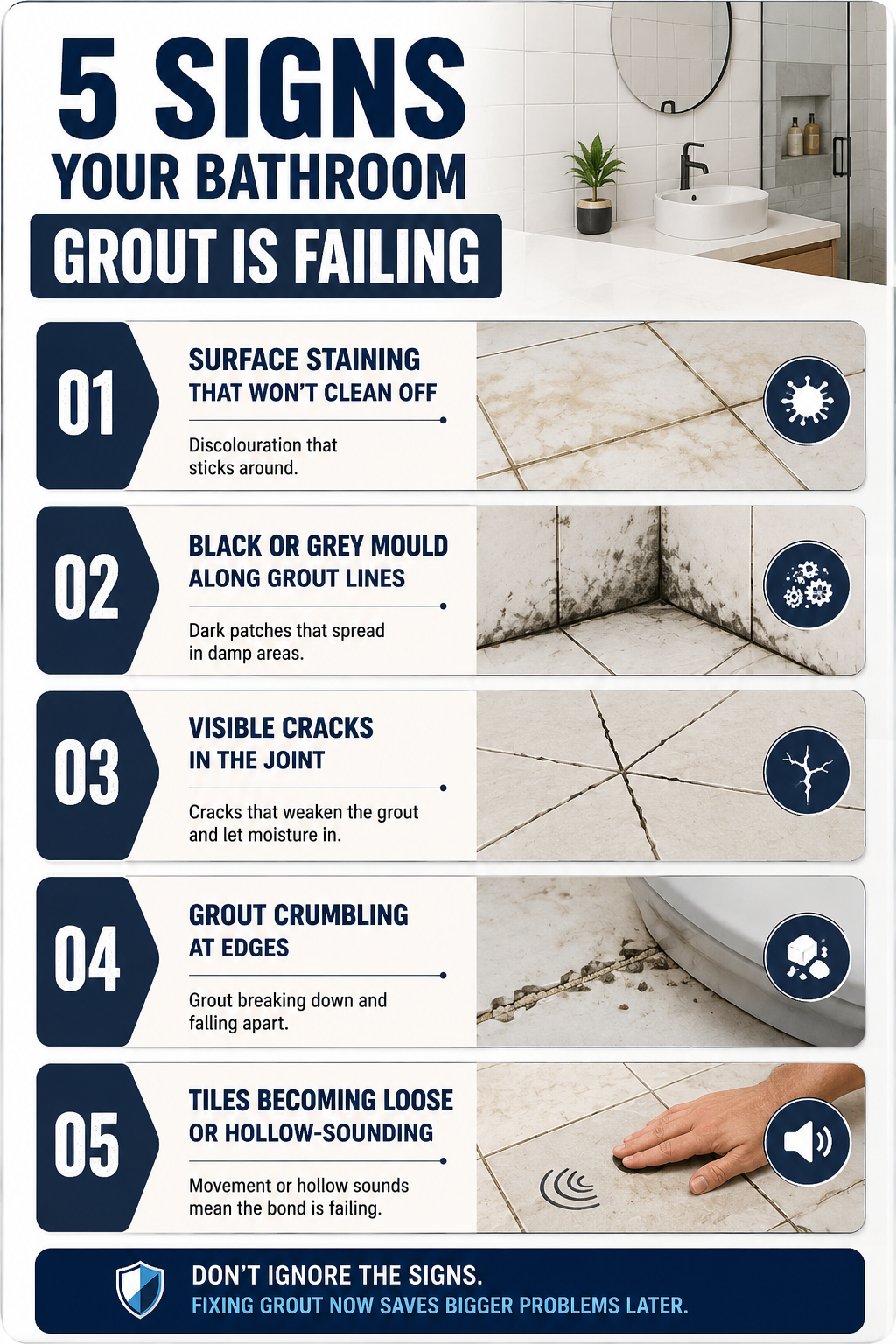
Grout failure is progressive, it typically begins with surface staining and discoloration, followed by black or grey mould appearing along grout lines, particularly in corners and near the floor. Over time, cracks develop, the grout begins to crumble and water starts penetrating behind the tiles. At that stage, the problem is no longer cosmetic. It becomes a waterproofing failure.
Why Epoxy Grout Performs Better in High-Moisture Areas
Better Resistance to Water
Water resistant epoxy grout is made from epoxy resins and a hardener rather than cement and water. This chemical composition makes it nearly impermeable, water does not absorb into the joint, which is the fundamental reason it outperforms cement grout in wet areas. Cement grout, by contrast, is a porous material that will absorb moisture unless it is sealed and even sealed cement grout does not resist water completely.
Stronger Protection Against Stains and Discolouration
Because epoxy grout does not absorb liquids, it resists soap scum, mineral deposits, and cleaning chemicals far more effectively. The colour of epoxy tile grout remains consistent over time — you can visualise grout colour options before committing to a shade. Cement grout in the same bathroom will begin to stain within months, particularly in white or light shades.
Lower Maintenance Requirements
Epoxy grout for tiles does not need to be sealed. It cleans easily with standard bathroom cleaners and does not require periodic re-sealing the way cement grout does. For busy families or commercial wet areas, this difference in maintenance load is significant over the life of the installation.
Better Durability in Frequently Used Bathrooms
Epoxy grout is harder and more chemically resistant than cement grout. It withstands the mechanical wear of regular cleaning, foot traffic on floor tiles, and the thermal expansion and contraction that comes with temperature changes in wet areas. Cement grout, particularly in high-use bathrooms, may begin to crack or crumble within a few years.
When Cement Grout Can Still Be a Practical Choice
Cement grout is not inherently the wrong material, it simply has a narrowing range of situations where it remains appropriate.
In dry or semi-dry interior spaces with minimal moisture exposure such as a powder room floor, a decorative wall feature or a backsplash in a low-splash zone cement grout with proper sealing can hold up reasonably well. Similarly, areas that see very light foot traffic and no direct water contact, like a display niche or a feature wall in a living room, present low enough risk for cement grout to perform without issue.
Where cement grout continues to make sense is in contexts where tiles are large-format with very narrow joints, limiting the exposed grout surface area and therefore limiting the opportunity for moisture ingress or staining. Likewise, in spaces that are infrequently used and easy to monitor, periodic re-sealing remains a manageable commitment.
Does the Higher Cost of Epoxy Grout Pay Off Over Time?
Understanding Upfront Cost vs Long-Term Cost
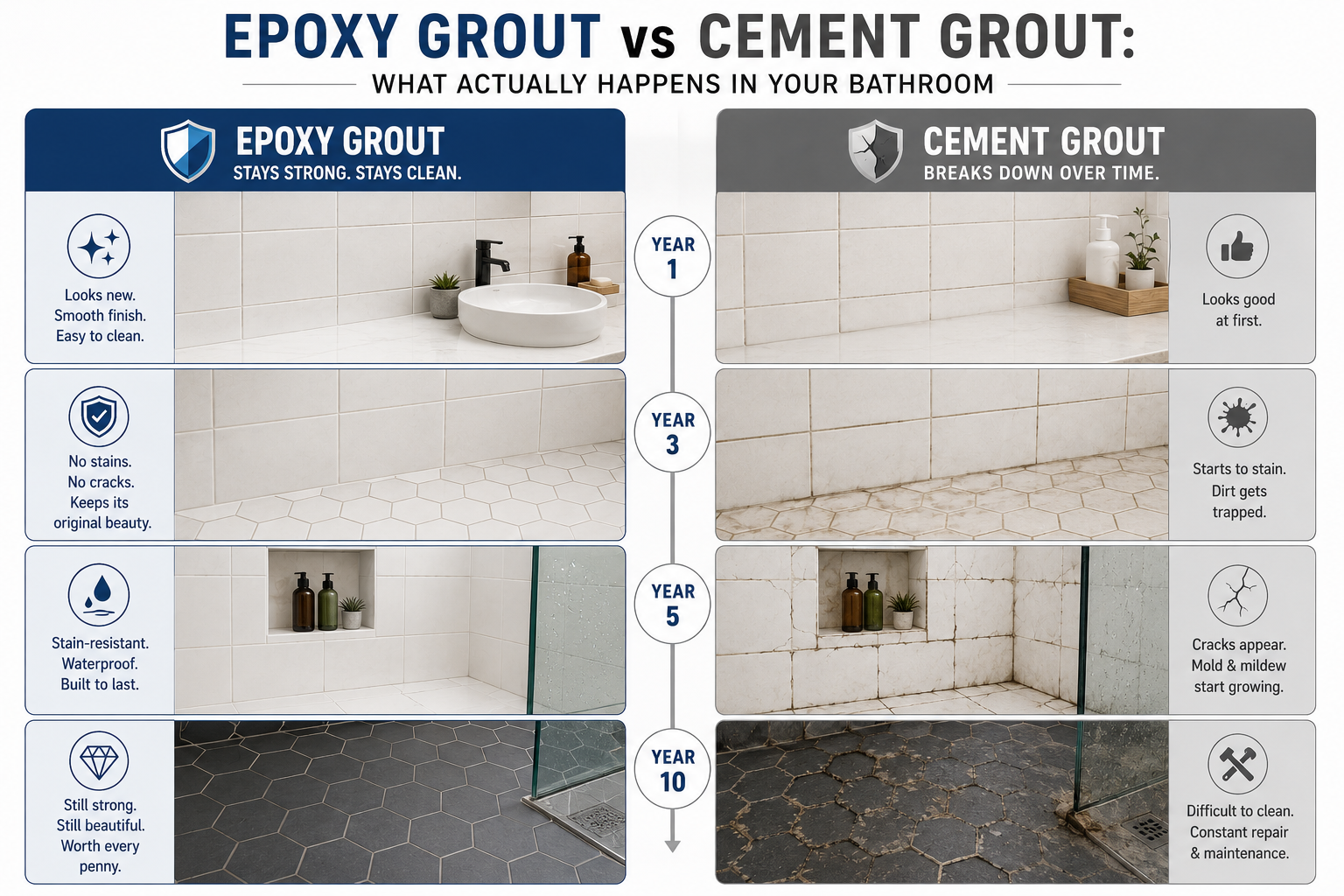
Epoxy grout costs more per kilogram than cement grout, and its application requires more care and experience. For a homeowner comparing line items in a renovation budget, the price difference is visible immediately. The long-term picture, however, is different.
Maintenance and Repair Considerations
Cement grout requires regular sealing, typically every one to two years in a bathroom setting and periodic repair or replacement as it cracks and deteriorates. Over a ten-year period, the cumulative cost of sealer products, professional cleaning, and partial re-grouting can exceed the original price difference between the two products.
Comparing a Family Bathroom and a Guest Bathroom
In a primary family bathroom used multiple times daily, epoxy grout typically pays for itself within three to five years by eliminating re-sealing costs and avoiding the early-stage repairs that cement grout commonly requires. In a guest bathroom used a few times a month, cement grout with regular sealing may remain serviceable for a decade.
Grout vs White Cement: Why They Are Not the Same
One of the most common mistakes in residential tile installations is using white cement as a substitute for tile grout the two products are not interchangeable.
White cement is a construction binder, it is designed for structural applications. Tile grout is a specifically formulated product designed to fill narrow tile joints while accommodating slight movement, resisting staining, and maintaining appearance. White cement has no flexibility, poor stain resistance, and absorbs water readily. It will crack faster in tile joints and cannot be sealed effectively.
Compared to grout, white cement also offers significantly lower water resistance and will discolour quickly in bathroom environments. The cost saving is not worth the performance trade-off.
Common Mistakes When Choosing Grout for Bathrooms
Experienced tile contractors and waterproofing applicators see the same errors repeatedly. Choosing grout based on price alone, without considering moisture exposure levels, is the most common. Using white cement instead of grout is a close second. Ignoring waterproofing requirements beneath the tile layer compounds the problem, even the best epoxy grout cannot compensate for a substrate that allows water ingress behind the tiles. Finally, assuming all grouts perform the same in all environments leads to cement grout being specified for shower areas where it will fail prematurely.
How to Choose the Right Grout for Your Bathroom?
Identify the moisture level
- Showers and wet zones need epoxy grout.
- Dry powder rooms can use cement grout.
Consider the tile type and joint width
- Large-format tiles with narrow joints have different grout requirements.
- Follow the manufacturer's recommendations.
Evaluate maintenance expectations
- Choose epoxy grout if you want minimal maintenance.
- Choose cement grout only if you're comfortable with periodic sealing.
Check the waterproofing system
- Ensure proper waterproofing beneath tiles.
- Use a compatible tile adhesive and grout system.
Select the right grout colour
- Match or contrast with the tile depending on the desired appearance.
- Consider stain visibility in high-use bathrooms.
Follow the manufacturer's installation instructions
- Mix and apply according to guidelines.
- Allow the recommended curing time before exposing the area to water.
What Professionals Consider Before Selecting Bathroom Grout
Contractors, architects, and tile applicators evaluating grout for a project weigh several factors beyond the product specification sheet. Moisture exposure level, whether the area is occasionally wet or constantly wet, is the primary filter. Tile type and joint width matter because some adhesives and substrates expand differently. Maintenance expectations set by the building owner affect whether a low-maintenance product like epoxy is worth the higher installation cost. Usage frequency and long-term performance requirements, particularly in commercial or rental properties, almost always point toward epoxy grout as the better specification.
Getting the Best Results from Epoxy Grout Starts with the Right Tile Installation System
Grout is one component of a complete tile installation system. Even the best waterproof epoxy grout will underperform if it is laid over poorly bonded tiles or an inadequately waterproofed substrate.
The tile adhesive used beneath the tiles determines how well the installation withstands movement and moisture ingress from below. A high-performance tile adhesive rated for wet area use ensures that tiles remain firmly bonded even when the substrate experiences thermal movement or moisture cycling. Paired with proper bathroom waterproofing beneath the tiled surface, a quality adhesive layer prevents water from migrating behind the tile layer entirely.
Magicrete Tile Grout is designed to work as part of this complete installation system, formulated specifically for Indian climatic conditions, compatible with a range of tile formats, and available in variants suited to both standard and high-moisture applications.
A system approach adhesive, waterproofing and grout specified together, consistently outperforms individual product decisions made in isolation. A long-lasting tile installation checklist is a practical way to make sure nothing gets missed.
Why Epoxy Grout Is Often the Better Long-Term Choice for Bathrooms
For most high-moisture bathroom environments, epoxy grout delivers better long-term performance across every dimension that matters: water resistance, maintenance burden, stain and mould resistance, appearance retention, and overall value across the life of the installation.
Cement grout has its place, particularly in lower-moisture areas and budget-sensitive projects where maintenance is manageable. But for showers, wet zones, and heavily used bathrooms, epoxy grout is the specification that professionals consistently choose when performance over five, ten, or twenty years is the benchmark.
Not sure which grout is right for your project? Speak to the Magicrete team for a recommendation based on your tile type, moisture exposure, and installation requirements.
FAQ
1. Is epoxy grout waterproof?
Epoxy grout is near-impermeable to water. Unlike cement grout, it does not require sealing and resists moisture absorption, making it effectively waterproof for tile installation purposes.
2. Is epoxy grout better than cement grout for bathrooms?
In most bathroom applications, particularly showers and high-use wet areas, epoxy grout outperforms cement grout in water resistance, stain resistance, mould resistance, and long-term durability.
3. Does epoxy grout need sealing?
No. One of the key advantages of epoxy grout is that it does not require sealing, which reduces ongoing maintenance costs compared to cement grout.
4. Can epoxy grout prevent mould growth?
Epoxy grout's near-impermeable surface significantly reduces the conditions in which mould can establish. Cement grout, by contrast, provides a porous surface that retains moisture and supports mould growth.
5. Is epoxy grout suitable for floor tiles?
Yes. Epoxy grout for floor tiles performs well under heavy foot traffic and wet floor conditions, making it a preferred choice for bathroom floors, wet room floors, and commercial wet areas.
6. What is the difference between grout and white cement?
Grout is a purpose-made product for filling tile joints, offering flexibility, stain resistance and in the case of epoxy grout, near-waterproof performance. White cement is a construction binder not designed for tile joints, it lacks flexibility, absorbs water readily, and discolours quickly.
7. Why is epoxy grout more expensive than cement grout?
Epoxy grout costs more due to its raw material composition (epoxy resins and hardener) and more demanding application process. However, its longer lifespan and reduced maintenance requirements typically offset the upfront cost difference over time.
8. How long does epoxy grout last?
With correct installation, epoxy grout can last 20 to 30 years or more. Cement grout in comparable conditions typically requires re-sealing every one to two years and partial replacement within five to ten years.
One-Stop Solution for all your Construction Needs
Contact Us