
-
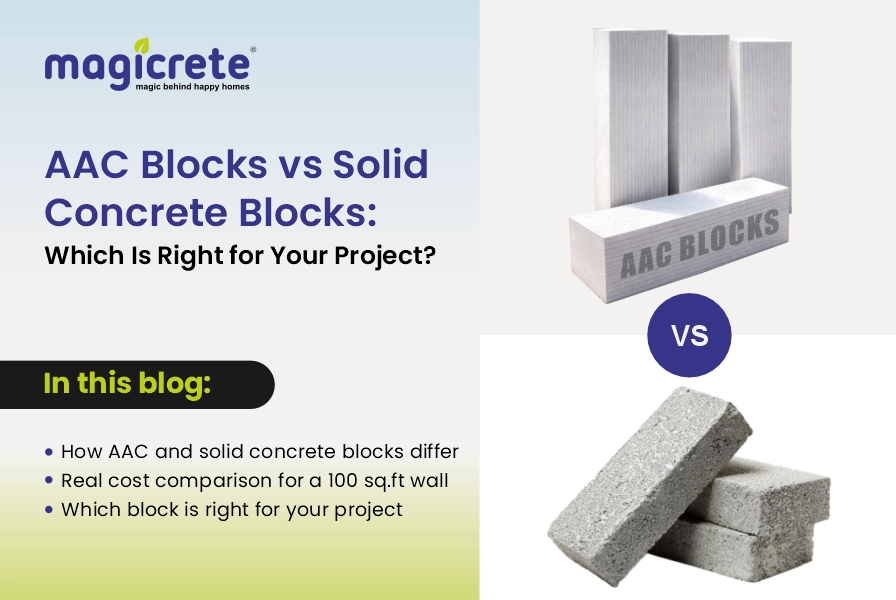
AAC Blocks vs Solid Concrete Blocks: Which Is Right for Your Project?
-

Magicrete
28 Sep 2026
Introduction
If you're comparing wall materials for your next project, Solid Concrete Blocks and AAC Blocks are probably both on your shortlist. Both are factory-made masonry units used across residential, commercial and industrial construction in India. They differ significantly in weight, cost, insulation and construction speed. This guide breaks down the real numbers so you can decide which one fits your project.
What Are Solid Concrete Blocks?
Solid concrete blocks are masonry units made from a dense mix of cement, sand and coarse aggregate. They are one of the most widely used walling solution in India because of their high compressive strength and long track record in both load-bearing and non-load-bearing applications. Their density makes them considerably heavier than AAC blocks of the same size.
What Are AAC Blocks?
AAC (Autoclaved Aerated Concrete) blocks are lightweight blocks made from fly ash, cement, lime, gypsum and a small quantity of aluminium powder. The aluminium powder creates millions of tiny air pockets during manufacturing. This cellular structure makes AAC blocks about 3x lighter than solid concrete blocks, and they still meet the compressive strength requirements of IS 2185 (Part 3) for wall construction.
Size Comparison
A standard Magicrete AAC block is 50% longer than a standard solid concrete block. This directly reduces the number of joints and the time needed to lay a wall of the same area.
Solid Concrete Block | Magicrete AAC Block | |
Size | 400 x 200 x 150 mm | 600 x 200 x 150 mm |
Wall Thickness | 6 inch | 6 inch |
Blocks per 100 sq.ft (approx.) | 120 pcs | 78 pcs |
Cost Comparison for a 100 Sq. Ft Wall (6-Inch Thickness)
Here is a cost breakdown for a 100 sq.ft, 6-inch-thick wall. It compares a solid concrete block wall with a Magicrete AAC block wall at Bangalore market rates.
Particulars | Magicrete AAC Block Wall | Concrete Block Wall |
Block Material Cost | ₹5,576 | ₹5,646 |
Mortar / Adhesive | ₹592 | ₹977 |
Sand-Cement Plaster | ₹3,500 | ₹7,000 |
Gypsum Plaster | ₹3,000 | ₹1,500 |
Coping | ₹844 | ₹844 |
Total Cost for 100 Sq.Ft Wall | ₹14,922 | ₹18,016 |
Rates are indicative and may vary with location, brand, supplier and time. Use this as a reference framework, and check current local rates before finalising your project budget.
Why the Total Cost Works Out Lower: The Construction System Difference
The AAC block's material cost is close to that of a concrete block. The real savings come from how the wall is built and finished. Here is how the two recommended wall systems differ on site.
Concrete Block Wall (6")
- The external face receives 12 mm of sand-cement plaster.
- The internal face receives 12 mm of sand-cement plaster followed by 6 mm of gypsum plaster.
- Blocks are laid with cement mortar joints of 10 to 12 mm.
Magicrete AAC Block Wall (6")
- The external face receives 12 mm of sand-cement plaster.
- The internal face receives 12 mm of gypsum plaster applied directly on the blocks as the finish.
- Blocks are laid with thin-bed adhesive joints of just 3 mm, such as Magicrete Block Jointing Mortar.
Thick mortar joints and a double layer of internal plaster add up quickly on a concrete block wall. The factory-precise dimensions of AAC blocks let you skip the internal sand-cement plaster entirely and use thin 3 mm joints. That is where a large share of the ₹3,094 saving comes from.
Weight Comparison
Weight is where the two materials differ most, and it affects much more than the wall itself. Magicrete AAC blocks are about 3x lighter than solid concrete blocks of the same size.
The lighter weight makes blocks easier to transport and handle. More importantly, it reduces the dead load your structure has to carry, which in turn affects foundation and structural design. Using AAC can deliver up to 15% savings in structural cost.
Structural and Performance Benefits of AAC Blocks
- Up to 15% structural savings: Because AAC is about 3x lighter, it reduces dead load, which saves steel and concrete in the RCC frame and the foundation.
- Up to 2x faster construction: Larger blocks, fewer joints and thin-bed adhesive raise masonry output from about 120 sq.ft to 200 sq.ft per day.
- No difficulty in MEP work: AAC blocks can be cut and chased easily for electrical conduits and plumbing lines.
- Up to 4x better thermal insulation: The air-filled cellular structure keeps interiors cooler and reduces cooling costs, and it also improves sound insulation.
- Lower plastering cost: No internal sand-cement plaster is needed.
- Cleaner construction: Precise, uniform blocks mean less on-site wastage.
- Environment-friendly: AAC blocks are made with fly ash, a recycled industrial by-product.
Which One Should You Choose?
For residential, commercial and high-rise wall construction, AAC blocks are the top choice for builders. They comfortably meet the compressive strength requirements of IS 2185 (Part 3) for wall applications. They also give you a lighter structure, a faster build and a lower overall wall cost. As the numbers above show, even a straightforward 100 sq.ft wall costs about 17% less with Magicrete AAC blocks.
Why Choose Magicrete AAC Blocks
- Magicrete AAC blocks are stronger for their weight, lighter, faster to build with and more economical than conventional solid concrete blocks.
- They are manufactured to IS 2185 (Part 3) standards for consistent quality.
- They are backed by Magicrete's nationwide manufacturing and distribution network.
- They have been proven across residential, commercial and high-rise construction.
FAQs
Do AAC blocks have enough strength for wall construction?
Yes. AAC blocks are manufactured to meet the compressive strength requirements of IS 2185 (Part 3) for wall construction, so they provide all the strength a non-load-bearing wall needs. Concrete blocks are denser and have a higher compressive strength rating, but a standard non-load-bearing wall does not need that extra strength. AAC delivers the strength a wall needs at about one-third of the weight.
Which is cheaper: AAC blocks or solid concrete blocks?
AAC is cheaper both per block volume and per finished wall. AAC is priced at about ₹4,000 per cubic metre against ₹4,050 for concrete blocks. For a 100 sq.ft, 6-inch wall, a solid concrete block wall costs about ₹18,016 and an equivalent Magicrete AAC block wall costs about ₹14,922. That is a saving of ₹3,094, or about 17%. The saving comes from fewer blocks, thinner joints, faster labour and no internal sand-cement plaster.
Do AAC blocks reduce foundation and structural cost?
Yes. AAC blocks are about 3x lighter than solid concrete blocks, so they reduce the dead load on the structure. This can lower the steel and concrete needed in the foundation and frame, with structural savings of up to 15%.
Is plastering required on AAC block walls?
AAC block walls do not need internal sand-cement plaster. Because the blocks have precise dimensions and a smooth surface, 12 mm of gypsum plaster can be applied directly as the internal finish. The external face still gets 12 mm of sand-cement plaster, which is the same as for a concrete block wall. By comparison, a concrete block wall needs 12 mm of readymix plaster on both faces plus a 6 mm gypsum layer inside.
Content
