

-
Modern Construction Materials in India: Types, Benefits, Applications & Selection Guide
-

Introduction
India's construction materials market is projected to grow from roughly $90 billion in 2025 to almost double by 2035, but the more interesting shift isn't the size, it's the mix. Government housing and infrastructure programs, data centers, and warehouses are pushing construction toward taller, denser, faster-built structures, which is why demand is tilting from traditional materials like red bricks toward AAC blocks, precast systems, and engineered panels built for speed and load efficiency.
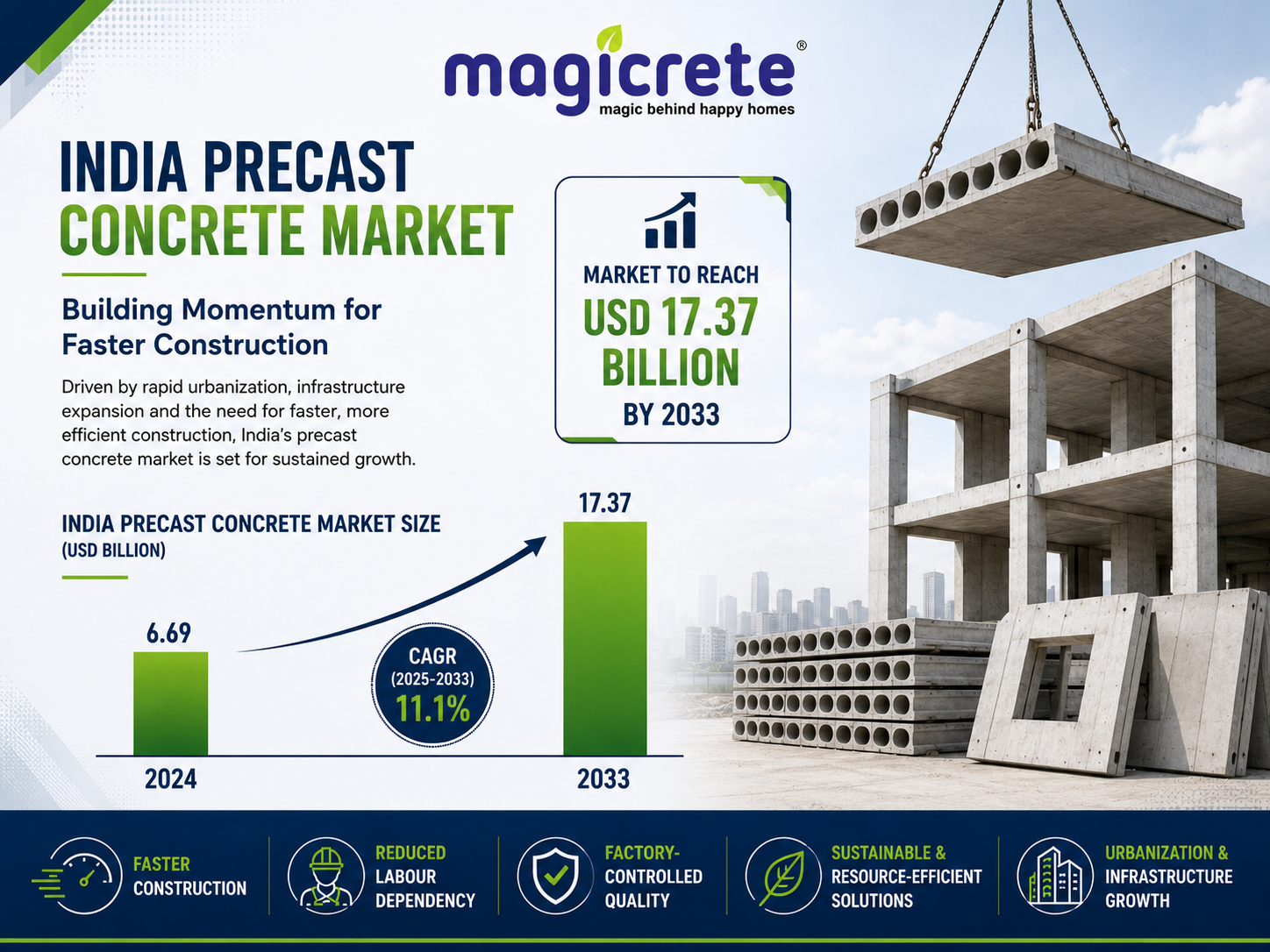
This shift shows up in the numbers wherever you look. India's precast concrete market alone is estimated at nearly $6.7 billion today and is projected to grow to over $17 billion within a decade, outpacing the overall construction materials market. Green-certified buildings have crossed 15.74 billion square feet nationally, spread across more than 19,000 registered projects, a footprint that barely existed a generation ago.
This guide breaks down exactly which modern construction materials are driving that shift, what they're genuinely good for, and how to choose the right one for your project without relying on guesswork.
Why Modern Construction Materials Transform the Construction Industry
Conventional materials like burnt clay bricks and site-mixed plaster served the industry for centuries, but they come with real constraints: long curing times, inconsistent quality between batches, heavy dependence on skilled masons, and material wastage that adds directly to project cost. As project timelines compress and labour availability tightens across Indian cities, these constraints show up as delays and cost overruns rather than minor inconveniences.
Modern building materials address this gap through factory-controlled manufacturing, standardised dimensions, and application-specific engineering. Builders adopt them primarily for three reasons: faster construction cycles, more predictable quality, and better long-term performance in areas like thermal comfort and structural durability.
India's construction sector is expected to grow at roughly 6–8% a year through 2031, and residential work alone already accounts for close to 45% of total construction value — which means even small efficiency gains per project scale into very large numbers nationally. The result is a construction process that is easier to plan, easier to execute with a leaner workforce, and easier to certify against green building norms like GRIHA and IGBC.
Types of Modern Construction Materials Used in India
Modern Wall Construction Materials
This category has seen the most visible shift in Indian construction. AAC (Autoclaved Aerated Concrete) AAC Blocks are now widely specified for internal partitions and infill walls in framed structures because of their light weight, dimensional accuracy, and thermal insulation. The weight difference is significant, AAC blocks weigh around 550 kg per cubic meter against roughly 2,400 kg per cubic meter for dense conventional concrete, nearly 75% lighter for the same wall volume. This translates directly into lower dead load on the structure and foundation.
Alongside blocks, AAC Wall Panels are gaining rapid ground for larger wall applications, offering factory-precast strength, faster installation, and superior sound and thermal insulation. For a full breakdown of how these stack up against the rest of the category, see this walling systems comparison. Fly ash bricks, concrete blocks, PUF panels, GFRG panels, and hollow blocks round out the category, each suited to a different combination of budget, span, and finish requirement.
Advanced Concrete & Structural Materials
Ready mix concrete has largely replaced site batching on organised projects because it removes variability from the mix design. High-performance concrete and structural steel are now standard on high-rise and infrastructure work, where speed of assembly and consistency across hundreds of repeated units matter more than on a single low-rise structure.
Precast & Prefabricated Construction Materials
Modular precast products — including columns, beams, staircases, load-bearing walls, hollow core slabs, prestressed slabs and bathroom pods, have emerged as the backbone of modern large-scale construction. Manufactured off-site under controlled factory conditions, these elements enable faster project completion, uniform quality, and reduced on-site labour dependency, making them the preferred choice for infrastructure, industrial, and repetitive-unit residential projects. The time, cost, and quality gap versus site-built construction is well documented, see our precast construction comparison.
Modern Finishing Materials
Ready mix plaster and gypsum plaster reduce wall-finishing timelines and cut material wastage compared to traditional sand-cement plastering. Wall render falls in the same category, engineered to deliver a uniform, crack-resistant finish with significantly less wastage than site-mixed plaster, making it ideal for both internal and external wall finishing.
Construction Chemicals & Waterproofing Solutions
Construction chemicals are the layer of the building that most often gets under-specified, yet they carry a disproportionate share of long-term performance and maintenance risk. This category includes tile adhesives, tile grouts (including epoxy grouts), wall putty, admixtures, sealants, waterproofing membranes, and protective coatings, each engineered to resist common failure points like cracking, delamination, and moisture-related staining when applied per the manufacturer's technical data sheet.
Choosing chemistry engineered to resist water ingress and matched to the substrate is usually far cheaper than any post-construction repair, especially for wet areas, tile installations, and exterior applications.
Sustainable & Green Building Materials
Engineered wood, geopolymer concrete, recycled aggregates, M-Sand, and other low-carbon materials are gaining ground as developers chase green certifications and as natural river sand becomes harder to source sustainably. AAC itself sits in this category too — see sustainable AAC construction. This segment is smaller in volume today but is the fastest-growing part of the market.
Summary Table
Material Category | Key Benefit | Typical Use |
AAC Blocks | Lightweight, thermally efficient masonry | Internal partitions, infill walls in framed structures |
AAC Wall Panels | Factory-precast strength, faster installation, superior insulation | Large wall applications, industrial and residential builds |
Precast Concrete Elements | Faster site assembly, consistent quality, reduced labour dependency | High-rise buildings, infrastructure, repetitive-unit projects |
Wall Render | Uniform finish, reduced material wastage | Internal and external wall finishing |
Tile Adhesives & Grouts | Engineered to resist cracking, delamination, moisture ingress | Vitrified tile, natural stone, large-format tile installation |
Waterproofing Solutions | Engineered to resist water penetration and long-term damage | Terraces, basements, wet areas |
Applications of Modern Construction Materials Across Sectors
Modern construction materials are not one-size-fits-all. Their adoption varies significantly across sectors, driven by unique demands around speed, load, thermal performance, durability, and long-term maintenance.
Residential Projects
Residential builders prioritise speed of delivery, thermal comfort, and long-term liveability. AAC blocks dominate the internal partition and infill wall segment because they are lightweight, dimensionally accurate, and offer excellent thermal insulation — keeping homes naturally cooler and reducing long-term energy costs for occupants. See how the numbers actually compare: AAC vs red bricks. Wall render is widely used for a smoother, faster finish that reduces material wastage. For high-rise residential projects, precast concrete elements like staircases, load-bearing walls, and bathroom pods are increasingly adopted to compress project timelines and maintain consistency across floors.
Commercial Buildings
Commercial construction — office complexes, malls, IT parks — demands large floor plates, rapid execution, and predictable quality. This is where precast concrete and structural steel play a critical role, enabling faster site assembly and column-free open floor plans. AAC wall panels are also gaining traction for their ability to cover larger wall areas quickly, while tile adhesives and grouts ensure premium finishes hold up to heavy footfall — see our vitrified tile adhesive guide for selection criteria in these high-traffic environments.
Data Centers
Data centers require precision, speed, and structural stability, often built on tight timelines to meet the growing demand for cloud infrastructure. Precast concrete elements are the go-to choice here, offering repeatable quality, faster installation, and the structural strength needed to house high-density equipment. AAC wall panels also serve as reliable walling, providing the thermal insulation critical for temperature-sensitive server environments, see why data centres choose AAC.
Industrial Projects & Warehouses
Industrial facilities and warehouses need materials that can withstand heavy loads, resist chemical exposure, and support fast, scalable construction. Precast concrete elements, including load-bearing walls, precast columns, and prestressed slabs, are widely adopted for their strength and rapid installation, especially in large-format warehouses. AAC wall panels are frequently used for partition and boundary walls because of their fire resistance and lightweight structure, see why Grade-A developers prefer fire-rated AAC panels over PUF for warehouses.
Hospitality & Institutional Projects
Hotels, hospitals, and educational institutions demand a balance of premium aesthetics, occupant comfort, and long-term durability. AAC blocks and wall panels are preferred for their sound insulation properties, critical in hospitality settings where guest comfort matters. Tile adhesives and epoxy grouts are also essential for hygienic, easy-to-maintain surfaces in kitchens and bathrooms, standard adhesive often fails here; see water-resistant tile adhesives.
Infrastructure & Public Projects
Metros, bridges, highways, and airports depend almost entirely on precast concrete and high-performance concrete because on-site casting at this scale is rarely practical or efficient. Precast elements enable projects to be assembled quickly with minimal disruption to surrounding areas, a critical requirement for urban infrastructure work, and one reason modular precast technology is gaining ground on large public projects.
How to Select the Right Modern Construction Materials
Based on Project Requirements
Match the material to the structural system already chosen. A framed structure with infill walls has very different material needs from a load-transferring precast system, so this decision should follow the structural design, not precede it.
Based on Climate & Location
Coastal projects need materials engineered to resist chloride and moisture exposure; high-seismic zones (as classified under IS 1893) need lightweight wall systems that reduce seismic mass, see AAC block IS standards for the applicable specs; hot, dry regions benefit most from materials with strong thermal insulation values.
Based on Budget & Long-Term Value
Compare total cost of ownership, not just landed material price, factor in labour productivity, wastage rates, and expected maintenance cycles over 10–15 years.
Based on Performance & Durability
Check the material's technical data sheet against the relevant IS standard for the application, for example, AAC compressive strength, and confirm any comparative or superlative performance claim is backed by test data before relying on it.
Questions to ask before choosing any material:
- Does this material suit the structural system and expected loads?
- Is a trained installation crew available locally? See this AAC panel installation guide.
- What does the technical data sheet specify for this exact application?
- What is the total cost over the building's lifecycle, not just at purchase?
Common Mistakes to Avoid When Using Modern Construction Materials
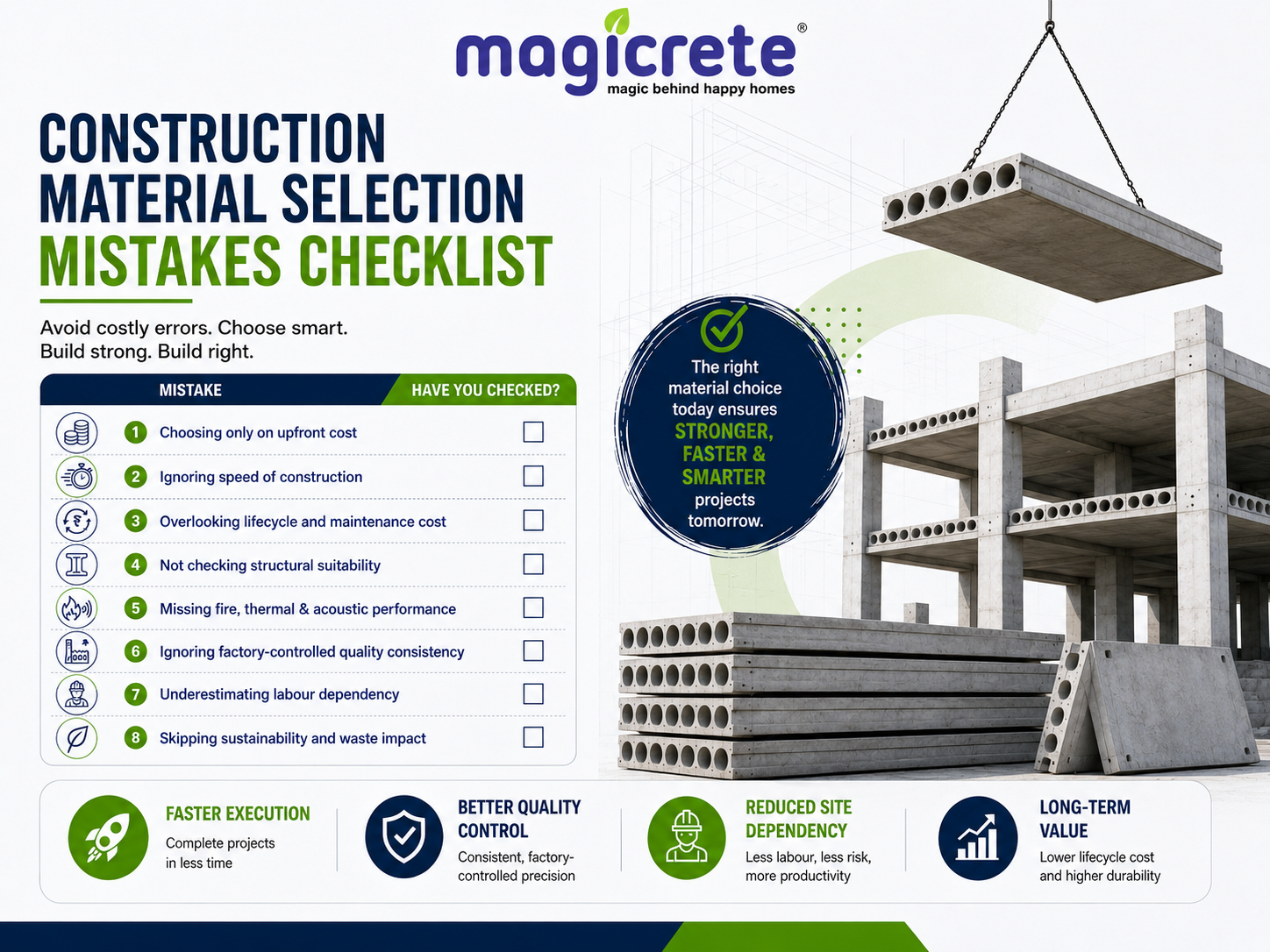
- Choosing materials based only on upfront cost, ignoring installation and lifecycle cost.
- Ignoring manufacturer installation requirements and curing or setting times, see these tile adhesive mistakes.
- Using incompatible materials together, such as mismatched plaster and block substrates, or treating cement vs tile adhesive as interchangeable.
- Buying without checking quality certifications or IS standard compliance.
- Overlooking the need for skilled, trained installation crews.
Challenges of Adopting Modern Construction Materials
Four challenges consistently slow adoption across Indian markets: limited availability in smaller towns, a shortage of labour trained on newer installation methods, higher initial cost compared with conventional alternatives, and compatibility questions when modern materials are introduced into an existing or partially built structure. None of these are permanent barriers, supply chains and training pipelines are expanding steadily, but they're worth planning around rather than discovering mid-project.
Frequently Asked Questions
1. What are modern construction materials?
Factory-engineered building materials such as AAC blocks, precast elements, and construction chemicals, designed for faster, more consistent construction than traditional site-made alternatives.
2. Which modern construction materials are most commonly used in India?
AAC blocks, ready mix concrete, precast concrete, tile adhesives, and waterproofing membranes see the widest use across Indian residential and commercial projects — see thisAAC blocks guide for the most widely adopted one.
3. Are modern construction materials better than traditional materials?
They generally offer faster construction and more consistent quality, though traditional materials can still suit small, budget-sensitive, or highly localised projects.
4. Which modern materials are best for residential construction?
AAC blocks, ready mix plaster, and tile adhesives are the most common choices for faster handover and reliable finishing in residential builds.
5. Do modern construction materials reduce overall construction costs?
They often lower total project cost through faster schedules and less wastage, even when the upfront material price is higher than conventional options.
6. What should I consider before selecting modern construction materials?
Match the material to your structural system, climate, budget, and confirm installation crew availability before finalising a choice.
7. Are modern construction materials suitable for all climate conditions?
Most have climate-specific variants, so the right choice depends on matching the material's engineered properties to local conditions rather than a one-size-fits-all pick.
One-Stop Solution for all your Construction Needs
Contact Us