
-
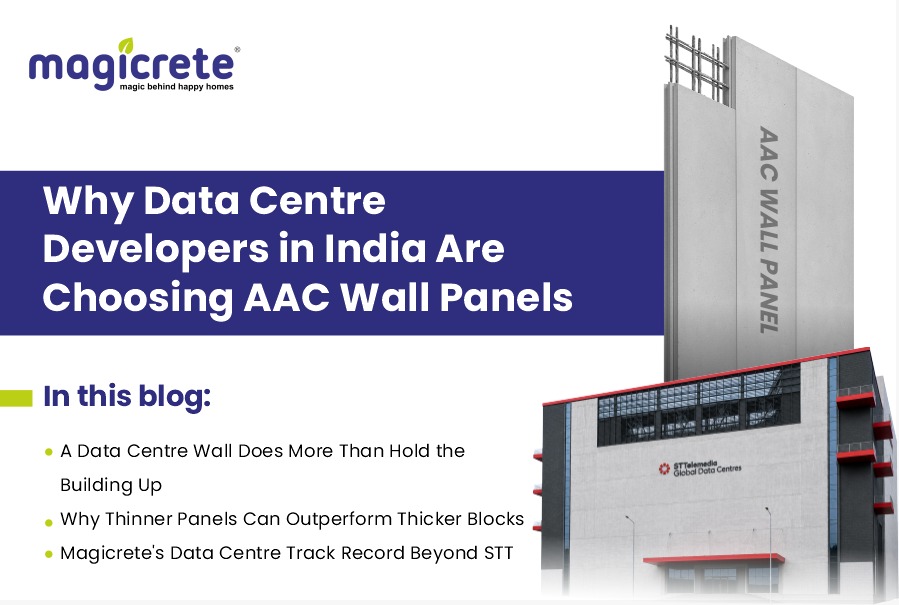
Why Data Centre Developers in India Are Choosing AAC Wall Panels Over Concrete Blocks
-

Magicrete
28 May 2026
Introduction
Data centre developers in India are replacing concrete block walls with AAC wall panels because panels cut HVAC cooling load by up to 30%, meet 4-hour fire ratings under IS 3809, and installed up to 16x faster on a documented Pune data centre project — without losing structural or fire performance. STT GDC proved this at Pune DC-04 and DC-05, both later occupied by Microsoft.
When STT GDC, one of India's leading data centre developers built its Pune DC-04 facility, the team made a decision that saved significant time and cost without compromising on performance. They replaced 200 mm solid concrete blocks with 150 mm Magicrete AAC Wall Panels across more than 50,000 sq. ft. of internal and external walls.
The result was a faster build, a lighter structure, better thermal performance, and the same fire rating the project required. STT DC-04 was subsequently occupied entirely by Microsoft. STT came back to Magicrete for DC-05.
That repeat decision tells you more than any spec sheet. When a developer builds two consecutive data centres with the same wall system, it is because the first one worked on every count that matters.
This blog explains what data centre developers and EPC contractors actually need from a wall system, and why AAC wall panels are increasingly the answer.
A Data Centre Wall Does More Than Hold the Building Up
Most building types treat the wall as a structural and weatherproofing element. A data centre wall has to do more than that. It directly affects three things that drive the operating cost and compliance of the facility: cooling efficiency, fire safety, and construction speed.
Cooling efficiency
Data centres run hot. The servers inside generate enormous amounts of heat, and keeping them within operating temperature is one of the biggest ongoing costs a data centre carries. A significant portion of that cooling load comes through the building envelope the walls, roof, and floor. A wall material that holds heat rather than resisting it forces the cooling system to work harder, which means higher energy bills every day the facility operates.
Concrete blocks have a thermal conductivity of around 2.1 W/mK (per standard material testing), meaning they transfer heat relatively easily. AAC wall panels have a thermal conductivity of 0.16 W/mK, roughly 13 times lower — a detailed breakdown of the thermal insulation benefits of AAC panels in Indian climates explains what this means for cooling costs in practice. Per Magicrete internal thermal testing, AAC panel buildings show HVAC energy consumption reduced by up to 30% compared to conventional masonry. For a data centre running cooling systems 24 hours a day, 365 days a year, that is a significant and recurring saving.
Fire safety
A fire inside a data centre is not just a safety incident, it is a catastrophic business failure. Servers, storage arrays, and networking equipment represent enormous capital investment. The data they hold is often irreplaceable. And the downtime caused by even a contained fire can result in contractual penalties and reputational damage that take years to recover from.
Data centre fire specifications typically require walls rated to 2 hours or above. Many Tier III and Tier IV facilities set an even higher bar. Magicrete offers certified 4-hour fire rated wall panels under IS 3809 completely non-combustible, with no foam core and no material that can fuel or accelerate a fire once it starts.
Construction speed
India's data centre capacity stood at around 950 MW in 2024 and is expected to more than double by 2026. Every developer in this space is racing to bring capacity online ahead of demand. A wall system that is faster to install, needs no plastering, and lets the next trade follow immediately is not a nice-to-have on these projects, it is a basic requirement.
The STT Story: What Actually Happened at DC-04 and DC-05
STT GDC Pune DC-04 is one of the clearest real-world case studies available for AAC wall panel performance in a data centre environment. The specifics are worth understanding.
The original specification for DC-04 called for 200mm solid concrete blocks, a standard choice for data centre construction at the time. The switch to 150mm Magicrete AAC wall panels was driven by a combination of factors: the panels could achieve the same structural and fire performance in a thinner profile, they reduced the dead load on the building frame, and they installed significantly faster without any requirement for plastering.
The thinner profile of the lightweight AAC wall panels panels also freed up usable floor area inside the facility — a real commercial benefit in a building where every square metre of computer room floor space generates revenue.
The facility was completed, commissioned, and subsequently taken over entirely by Microsoft, one of the most demanding data centre occupiers in the world from a technical and compliance perspective. STT returned to Magicrete for DC-05. This was not a sentimental decision, it was a procurement call based on demonstrated performance.
Why Thinner Panels Can Outperform Thicker Blocks
One question that comes up when evaluating AAC panels against concrete blocks is straightforward: if the panel is thinner, how can it perform as well? The answer is that performance in a wall system is not determined by thickness alone it is determined by the material properties of what the wall is made from. Here is how the comparison plays out on the parameters that matter most on a data centre project:
Parameter | 200 mm solid concrete block | 150 mm Magicrete AAC wall panel |
|---|---|---|
Thermal conductivity | ~2.1 W/mK — transfers heat readily | 0.16 W/mK — highly resistant to heat transfer |
HVAC energy impact | High cooling load through the envelope | Up to 30% reduction in HVAC energy consumption |
Fire resistance | Varies by block and mortar specification | 4 hours — certified under IS 3809 |
Combustibility | Non-combustible | Non-combustible |
Dead load on structure | High — dense material adds significant weight | Low — lightweight panel reduces structural load |
Plastering required | Yes — adds time and cost | No — factory finish, ready for painting directly |
Usable floor area | Reduced — 200 mm wall takes more space | Better — 150 mm profile recovers floor area |
Max height without intermediate structure | Limited by block stacking height | Up to 6 m — steel-reinforced panel stands independently |
Panel Specifications for Data Centre Projects
Specifying AAC wall panels for a data centre project comes down to matching thickness, span, and seismic requirement to the facility's structural design. Magicrete AAC wall panels are manufactured to the following specification range:
- Thickness: 75mm, 100mm, 120mm, 150mm, and 200mm — selected per load, span, and fire/acoustic requirement
- Standard width: 600mm, with length customisable from 2400mm to 3000mm
- Maximum unsupported height: up to 6 metres without intermediate beams or bond beams
- Seismic performance: engineered for use up to Zone IV under IS 1893 (Part 1): 2016, with mechanical L-clip and Z-bracket connectors that accommodate inter-storey drift without cracking
- Weight: approximately 60% lighter than equivalent-thickness solid concrete, reducing dead load on the structural frame
For server halls and plant rooms specifically, thickness and reinforcement are typically selected to balance fire rating against acoustic performance, panels in this range have been used effectively to manage generator and plant-room noise transfer in operational facilities.
The Cooling Cost Argument
For a data centre developer or facility manager, the thermal performance argument is worth spelling out clearly because it affects the bottom line of the business, not just the construction budget.
A concrete block wall with a thermal conductivity of 2.1 W/mK acts almost like a conductor, it absorbs heat from outside and lets it pass through into the interior. In a tropical climate like most of India, this means the cooling system is constantly fighting heat coming in through the walls.
An AAC wall panel at 0.16 W/mK acts more like an insulator. Far less heat gets through, and the cooling system has less work to do. That saving compounds every hour the facility operates. For a large data centre running cooling systems continuously, the difference in energy cost between a well-insulated and a poorly insulated envelope can run into crores of rupees over the life of the facility.
This is why data centre developers who think in terms of total cost of ownership rather than just construction cost tend to choose AAC panels. The construction cost is a one-time spend. The cooling cost is ongoing for the life of the building.
What the Data Centre Construction Timeline Looks Like with AAC Panels
Speed matters in data centre construction in a specific way. These are not projects where a six-month delay is an inconvenience, they are projects where delay directly costs the developer revenue, because colocation customers are waiting for rack space and hyperscalers have committed go-live dates.
Here is how AAC wall panel installation changes the construction programme compared to conventional block masonry:
- On the STT DC-04 project, the switch from 200mm concrete blocks to AAC wall panels delivered up to 16x faster construction
- No plastering required — the factory finish is paint-ready, removing that entire trade from the programme
- MEP teams can begin chasing and fitting immediately after panels are erected, with no waiting for plaster to dry
- Panels span up to 6 metres in height without intermediate beams, reducing steelwork and simplifying installation sequencing in high-bay server rooms and equipment halls
- Crane-assisted installation with a small erection team means fewer workers on site and a faster, safer installation process
For a developer managing multiple data centre projects simultaneously, as most large players now are, that time saving multiplies across the portfolio.
India's Data Centre Boom and the Infrastructure It Needs
India's data centre market is growing faster than almost any other infrastructure category in the country. Hyperscaler demand, driven by Microsoft, Google, Amazon, and domestic players is creating a pipeline of large, complex facilities that need to be built quickly and built to international compliance standards.
The scale of this growth means developers cannot afford to re-evaluate every material from scratch on each new project. Wall specifications that have already been proven on completed, operational facilities get standardised and carried forward. That is exactly what is happening with Magicrete AAC Wall Panels across India's data centre sector.
Magicrete's Data Centre Track Record Beyond STT
STT DC-04 and DC-05 are the most detailed reference projects in Magicrete's data centre portfolio but they are not the only ones. Magicrete AAC Wall Panels have since been supplied and erected across multiple completed data centre facilities for some of India's most active developers in this space.
Adani Connex
Adani Connex, the data centre joint venture between the Adani Group and Edge ConneX is among India's fastest-growing hyperscale data centre developers. Magicrete AAC Wall Panels were specified and installed across their facility, meeting the thermal, fire, and speed requirements that large-footprint hyperscale construction demands. The lightweight panel system was particularly relevant here reducing dead load on the structure and allowing faster enclosure of the building envelope across the large floor plate.
Lumina CloudInfra
Lumina CloudInfra, one of India's emerging colocation data centre players, chose Magicrete AAC Wall Panels for their facility. For a developer bringing a new facility to market on a compressed timeline, the no-plastering advantage was directly relevant MEP teams could begin installation immediately after wall erection, keeping the commissioning schedule on track. The 4-hour fire rating also supported the facility's compliance requirements without the need for supplementary fire protection systems layered onto the wall.
CtrlS Datacenters
CtrlS Datacenters, Asia's largest rated data centre company, operates Tier IV certified facilities, the highest classification available, requiring the most stringent standards for redundancy, fire protection, and structural integrity. Magicrete AAC Wall Panels were used in their facility construction, where the 4-hour certified fire resistance and non-combustible material composition directly supported the Tier IV fire safety specification. The dry installation method also meant no curing-related humidity was introduced into the building environment during construction, relevant in a facility where sensitive equipment installation runs in parallel with civil works.
Taken together, these projects represent a cross-section of India's data centre landscape, hyperscale, colocation, and Tier IV certified. Magicrete AAC Wall Panels have been delivered and erected across all of them. For a developer or EPC contractor evaluating wall systems for a new data centre project, this breadth of completed reference projects, at different scales, for different operators, across different compliance frameworks is a meaningful indicator of where the market is heading.
What to Ask When Specifying Walls for a Data Centre Project
If you are specifying or procuring wall systems for an upcoming data centre project, these are the questions that should drive the evaluation:
What is the fire resistance rating, and is it certified under IS 3809?
What is the thermal conductivity of the wall material, and what does that mean for HVAC sizing and energy cost?
Does the system require plastering, and if so, how does that affect the programme?
Can the panels span the full height of server halls and plant rooms without intermediate structural elements?
Magicrete AAC Wall Panels answer all of these questions clearly and with a track record of completed projects to back them up.
Magicrete AAC Wall Panels have been supplied and erected across STT GDC Pune DC-04 and DC-05 (DC-04 occupied by Microsoft), Adani Connex, Lumina CloudInfra, and CtrlS Datacenters.Talk to the Magicrete team about wall system specifications for your next data centre project.
FAQ's
1. What fire rating do AAC wall panels have for data centres?
Ans. Magicrete AAC wall panels carry a certified 4-hour fire rating under IS 3809. The panels are non-combustible with no foam core, meeting or exceeding the 2-hour minimum most Tier III and Tier IV data centre specifications require.
2. How much do AAC wall panels reduce cooling costs in a data centre?
Ans. AAC wall panels have a thermal conductivity of 0.16 W/mK versus roughly 2.1 W/mK for solid concrete blocks. In practice this has been shown to cut HVAC energy consumption by up to 30% compared to conventional masonry, a significant saving for facilities that run cooling systems continuously.
3. How much faster is AAC wall panel installation compared to concrete blocks?
Ans. On the STT GDC Pune DC-04 project, switching from 200mm solid concrete blocks to 150mm Magicrete AAC wall panels delivered up to 16x faster construction, driven by dry-fix installation and the elimination of plastering.
4. Do AAC wall panels require plastering?
Ans. No. AAC wall panels arrive with a factory finish that is ready for paint directly, removing plastering from the construction programme entirely and allowing MEP teams to begin work immediately after erection.
5. What is the maximum wall height for AAC panels without additional structural support?
Ans. Magicrete AAC wall panels span up to 6 metres without intermediate beams or bond beams, which simplifies installation in high-bay server rooms, plant rooms, and equipment halls.
6. Are AAC wall panels suitable for seismic zones?
Ans. Yes. AAC wall panels are engineered for use up to Seismic Zone IV under IS 1893 (Part 1): 2016. Their lower mass compared to dense concrete reduces inertial forces during a seismic event, and mechanical L-clip and Z-bracket connectors allow the panel to accommodate inter-storey drift without cracking.
7. What sizes and thicknesses do AAC wall panels come in?
Ans. Magicrete AAC wall panels are available in 75mm, 100mm, 120mm, 150mm, and 200mm thicknesses, with a standard width of 600mm and length customisable from 2400mm to 3000mm, allowing the panel to be specified to the exact load and span requirement of the project.
8. Which data centres in India use Magicrete AAC wall panels?
Ans. Magicrete AAC wall panels have been supplied and erected across STT GDC Pune DC-04 and DC-05 (DC-04 subsequently occupied by Microsoft), Adani Connex, Lumina CloudInfra, and CtrlS Datacenters — spanning hyperscale, colocation, and Tier IV certified facilities.
Content
- Introduction
- A Data Centre Wall Does More Than Hold the Building Up
- The STT Story: What Actually Happened at DC-04 and DC-05
- Why Thinner Panels Can Outperform Thicker Blocks
- The Cooling Cost Argument
- What the Data Centre Construction Timeline Looks Like with AAC Panels
- India's Data Centre Boom and the Infrastructure It Needs
- Magicrete's Data Centre Track Record Beyond STT
- What to Ask When Specifying Walls for a Data Centre Project
- FAQ's
