
-
AAC Panels for Warehouses in India: Why Grade-A Developers Are Replacing PUF Panels
-

Introduction
A fire in a warehouse is not just a safety incident, it is a business continuity failure. Today, AAC panels for warehouses in India are increasingly being evaluated as a safer alternative to conventional walling systems. In December 2021, a large logistics facility in the Mumbai Metropolitan Region suffered a major fire that spread rapidly through its PUF-clad envelope, destroying stored inventory worth hundreds of crores and triggering extended business interruption for four 3PL tenants. The facility was not unusual; it was typical of how most Indian warehouses were built through the 2010s.
The insurance underwriters took note. So did the Grade-A developers. And so, quietly but decisively, did the procurement teams at the country's largest 3PL and e-commerce logistics operators.
What is changing is not the appetite for fast-track warehouse construction that remains as urgent as ever. What is changing is the fire performance requirement attached to the envelope. And that shift is rendering PUF panel systems increasingly difficult to justify on projects where tenant quality, insurance premiums, and long-term asset value matter.
This article examines why AAC wall panels are replacing PUF as the envelope material of choice for Grade-A warehouse development in India, and what the decision looks like from a developer's and EPC contractor's perspective.
Why PUF Panels Fall Short in Warehouse Fires
Polyurethane foam (PUF) sandwich panels gained dominance in Indian industrial construction for a straightforward reason: they are fast to install, lightweight, and deliver good thermal insulation for temperature-controlled storage. For cold chain logistics, they remain the default for insulated roof and ceiling assemblies.
A simplified view of how fire behaves in different walling systems:
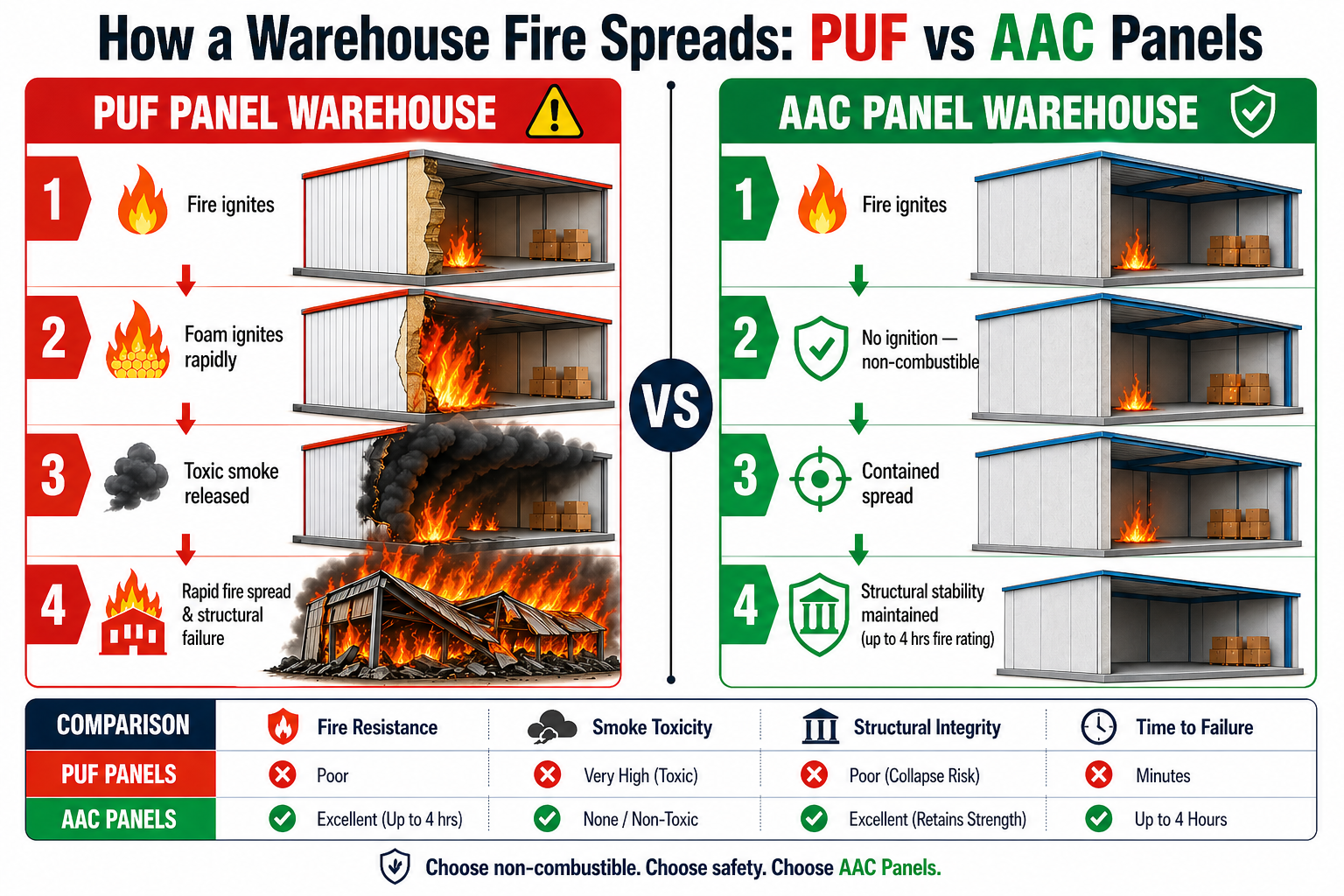
But PUF panels carry a fundamental limitation that their widespread use has obscured: For a detailed comparison, see AAC panels vs PUF panels. Their fire resistance rating is approximately 1 hour under standard test conditions. Under real fire conditions, particularly in warehouse environments where stored goods create substantial fuel loads, performance can be significantly worse. The foam core is combustible. When exposed to sufficient heat, it ignites and releases toxic gases including hydrogen cyanide and carbon monoxide, which are typically the cause of fatality before structural collapse.
The National Building Code of India 2016 mandates different fire resistance ratings by occupancy type and building height. These requirements align with broader construction site safety rules and regulations in India that prioritise fire protection in industrial buildings.
For large-footprint warehouses classified as high-hazard storage occupancies, the code's provisions — combined with the specific requirements imposed by insurers and institutional tenants frequently require 2-hour to 4-hour rated walls.
A PUF panel wall with a 1-hour rating does not meet this threshold. A AAC wall panel at 100 mm thickness carries a certified 4-hour fire resistance rating under IS 3809. The gap is not marginal, it is the difference between compliant and non-compliant.
"Wall panels are no longer evaluated on installation speed alone. The first question from institutional tenants now is: what is the fire rating, and what is the insurance classification of the envelope?"
Fire Rated Wall Panels for Warehouses: Insurance and Tenant Shift
The decision to move away from PUF panels is rarely made in the engineering department first. It typically arrives in one of three forms: an insurer declining to offer preferred rates on a PUF-clad facility, a marquee tenant specifying a minimum fire resistance rating as a lease condition, or a financing institution raising the question of envelope specification in due diligence.
FM Global, the industrial insurer whose standards are referenced by a significant share of MNC occupiers in Indian logistics parks, maintains data-driven fire protection requirements that include envelope performance. Facilities that do not meet FM Global or equivalent standards face higher premiums, sometimes materially so, or outright declination by preferred underwriters.
For a 5-lakh sq. ft. Grade-A distribution centre where annual insurance costs run into crores, the premium differential between a compliant and non-compliant envelope is not an abstraction. It is a recurring operating cost that flows directly to the developer or tenant depending on the lease structure.
The move to AAC panels, in this context, is not a technical preference. It reflects the growing adoption of AAC panels for warehouses in India where fire compliance and long-term asset value are critical. It is a commercial decision driven by the cost of capital, insurance, and the requirement to attract institutional-quality tenants at institutional-quality rents.
Warehouse Construction in India: Speed vs Fire Compliance
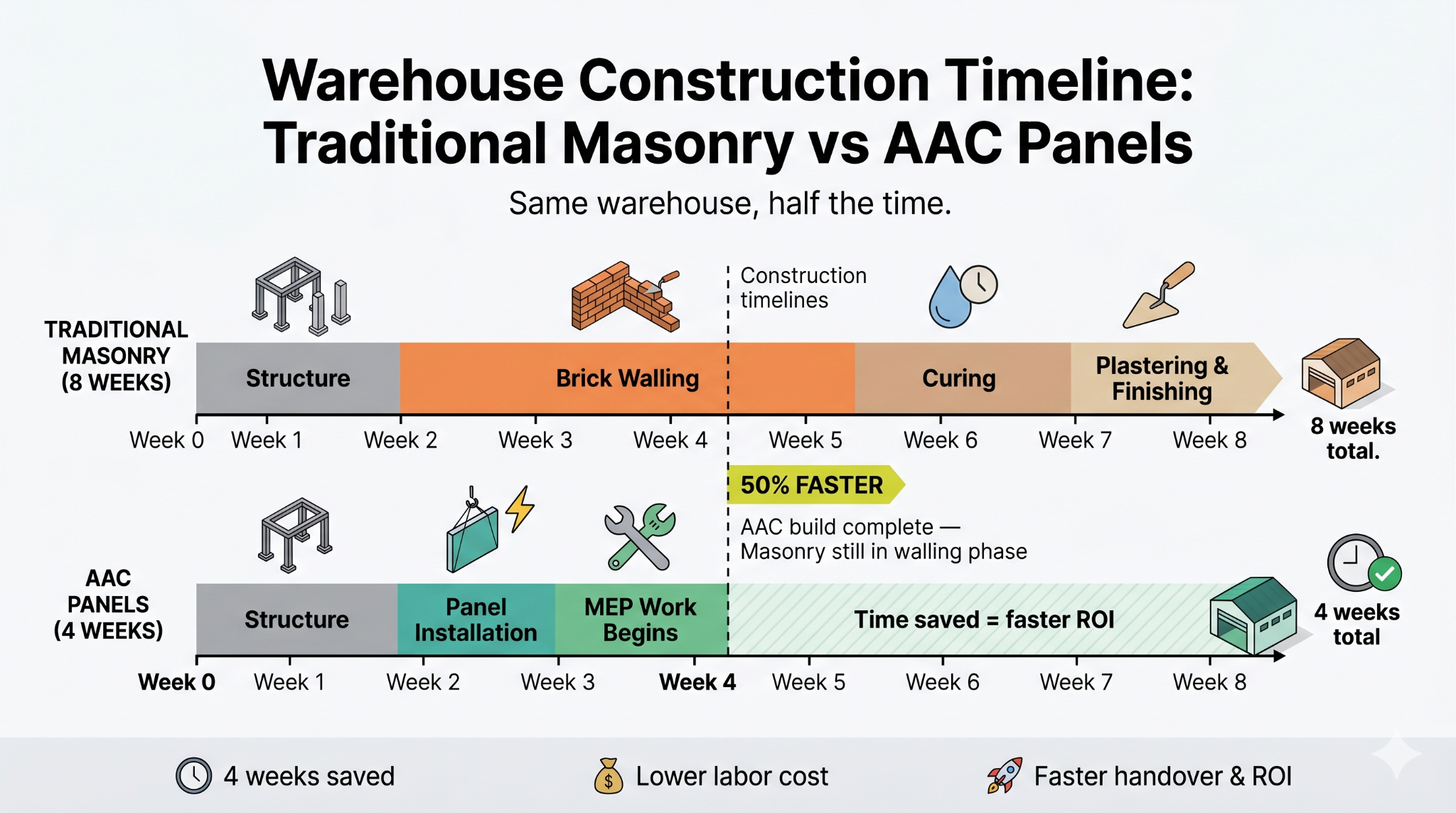
A large-scale industrial warehousing project in Maharashtra resolved this objection at scale. The project mandate was to enclose 50,000 sq. ft. of warehouse structure, watertight, before monsoon. Conventional walling options, including blockwork masonry, were evaluated and rejected: their sequential construction logic, mandatory curing cycles, and multi-trade dependencies made the deadline mathematically unachievable.
What this looks like in execution timelines:
This shift reflects a broader move towards modern walling systems in industrial construction.
Magicrete AAC Wall Panels were selected. Steel-reinforced 100 mm panels, reaching heights of up to 6 metres, were installed using crane-assisted erection on the PEB frame. The entire 50,000 sq. ft. envelope was completed in a few weeks.
For execution details, refer to the AAC wall panel installation guide.
Key performance outcomes from the Maharashtra project:
- 16× faster than traditional brick masonry
- 4× faster than conventional AAC blockwork
- Zero internal plastering required, factory finish direct to surface
- MEP works commenced weeks ahead of the original programme
- Cleaner, safer site environment with no wet trades
The critical point is that AAC panels did not require the developer to choose between fire compliance and speed. The system delivered both and eliminated plastering cost and timeline entirely.
The Tall-Wall Limitation of PUF Panels
Modern logistics facilities are not the 4-metre-clear-height sheds of a decade ago. Grade-A warehouses serving e-commerce and modern 3PL operators routinely require clear internal heights of 10–12 metres, with structural wall heights of 6 metres and above between column lines and intermediate beams.
PUF sandwich panels are structurally limited to approximately 3 metres in height without additional framing elements. Achieving 6-metre walls with PUF requires intermediate structural steel rails, adding material cost, connection complexity, and installation time.
Magicrete AAC Wall Panels, reinforced with corrosion-protected steel, are engineered to span up to 6 metres between floor and roof beam without intermediate columns or beams. This is not a workaround, it is the design intent of the panel system. The structural self-sufficiency of the panel eliminates a layer of steel fabrication, connection detailing, and erection sequencing that PUF systems require.
For warehouse envelopes where column grids are wide and clear heights are maximised, this capability directly reduces structural cost while simultaneously improving fire performance.
AAC vs PUF Panels: Key Specification Comparison
Setting aside the marketing language of both systems, the specification comparison on the parameters that matter most to warehouse developers and their tenants is as follows:
Parameter | AAC Wall Panels (100 mm) | PUF Sandwich Panels (50 mm) | Advantage |
Fire resistance rating | 4 hours (IS 3809 certified) | ~1 hour | AAC |
Combustibility | Non-combustible | Combustible foam core | AAC |
Toxic fume emission in fire | None | HCN, CO — high risk | AAC |
Max panel height (without extra framing) | Up to 6 metres | ~3 metres | AAC |
NBC 2016 compliance for high-hazard occupancy | Yes | Requires supplementary measures | AAC |
Lifespan | 50+ years (building life) | 10–15 years (delamination, corrosion risk) | AAC |
How Developers Are Choosing Between AAC and PUF Panels
At a glance, here’s how developers evaluate walling systems:
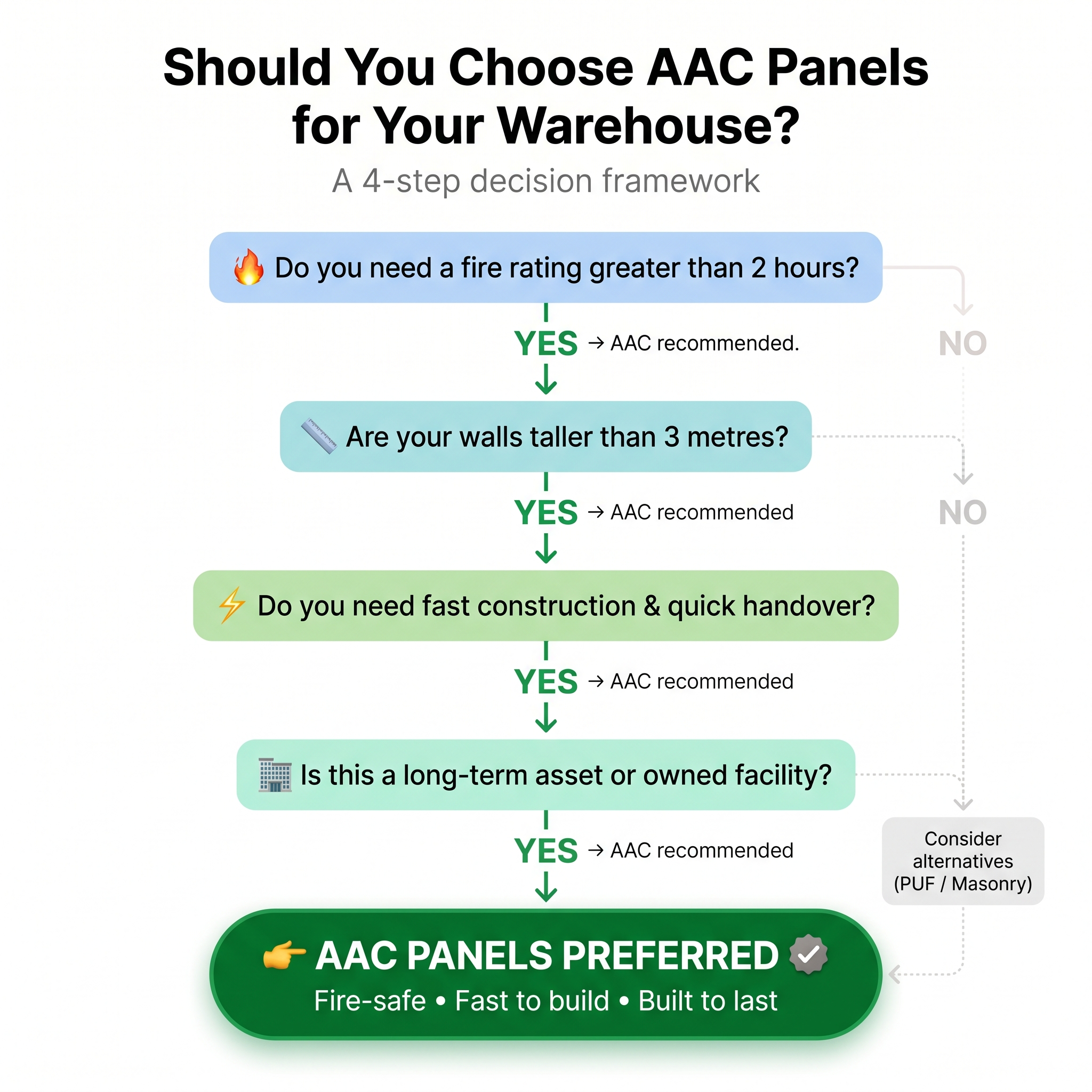
For a Grade-A warehouse developer evaluating envelope specification on an upcoming project, the decision is now structured around four questions rather than one:
1. What fire resistance does my target tenant or insurer require?
If the answer is 2 hours or above which it is for most institutional 3PL, e-commerce, and manufacturing tenants, PUF panels require supplementary fire protection systems that eliminate their cost advantage and the clear choice here is AAC Wall Panels with a fire-rating of up to 4 hours.
2. What is the clear internal height, and therefore the structural wall height?
Above 3 metres, PUF panels require intermediate structural framing. AAC panels self-support to 6 metres, removing a layer of steelwork from the cost model.
3. What is the construction deadline and what are the weather risks?
AAC panels installed in a crane-assisted PEB workflow achieve enclosure speed that matches or exceeds PUF on large-footprint buildings, while eliminating plastering and the wet-trade schedule risk it carries.
4. What is the asset's intended holding period?
PUF panels have a realistic lifespan of 10–15 years before delamination, corrosion, and joint failure require envelope remediation. For a 25-year holding period, the developer is budgeting at least one complete envelope replacement. AAC panels, lasting the life of the building, make that cost disappear from the model.
Magicrete AAC Wall Panels are deployed across Reliance Retail warehouses, industrial logistics hubs in Maharashtra, and distribution centres nationally.Contact the Magicrete technical team to review envelope specifications for your next warehouse or logistics project.
Planning a warehouse project?
Evaluate fire safety, cost, and performance with AAC Wall Panels. Or visit Magicrete Building Solutions to explore complete walling solutions.
FAQ's
1. Are AAC panels better than PUF panels?
Ans: Yes, AAC panels offer higher fire resistance and are non-combustible.
2.What is the fire rating of AAC wall panels?
Ans: Up to 4 hours as per IS 3809.
3.Why are warehouses shifting to AAC panels in India?
Ans: Due to fire safety, insurance compliance, and long-term durability.
One-Stop Solution for all your Construction Needs
Contact Us