
-
AAC Wall Panels vs PUF Panels: Which Walling System is Better for Modern Infrastructure?
-

Introduction
While multiple walling materials exist in modern construction, developers are increasingly standardizing toward AAC Wall Panels because of their ability to deliver structural reliability, fire safety, thermal stability, and acoustic comfort within a single system.
Unlike insulation-focused alternatives that are limited to niche environments, AAC panels are engineered to perform consistently across a wide spectrum of building categories.
Understanding the Fundamentals: AAC Wall Panels vs PUF Sandwich Panels
Before comparing technical parameters, it is essential to understand how these materials are designed and what purpose they serve in modern infrastructure.
What are AAC Wall Panels?
AAC Wall Panels are steel reinforced panels manufactured using cement, lime, sand, water, and an aerating agent. The autoclaving process creates a uniform microcellular structure that delivers an optimal balance of strength, weight reduction, and insulation.
Key characteristics:
- Steel-reinforced for added stiffness
- Lightweight yet structurally robust
- Non-combustible mineral composition
- Excellent thermal and acoustic properties
- Suitable for permanent buildings
Because of their monolithic behavior, AAC panels provide the solid feel of masonry with the speed of precast construction.
What are PUF Sandwich Panels?
PUF Sandwich Panels consist of a rigid polyurethane foam core bonded between two metal sheets, typically galvanized steel or aluminum.
They are primarily engineered for insulation-driven applications rather than structural performance.
Key characteristics:
- Extremely low thermal conductivity
- Fast installation
- Lightweight construction
- Factory-finished surfaces
PUF panels perform exceptionally well in temperature-controlled environments, but their mechanical strength and fire performance often require careful evaluation when used in occupied buildings.
Structural Performance: Why Stiffness Defines Long-Term Durability
A common misconception is that because both systems are non-load-bearing, their structural behavior is identical. In reality, impact resistance determines how walls perform under the daily rigors of a high-traffic environment.
The Gold Standard: Impact Resistance as per BS 5234
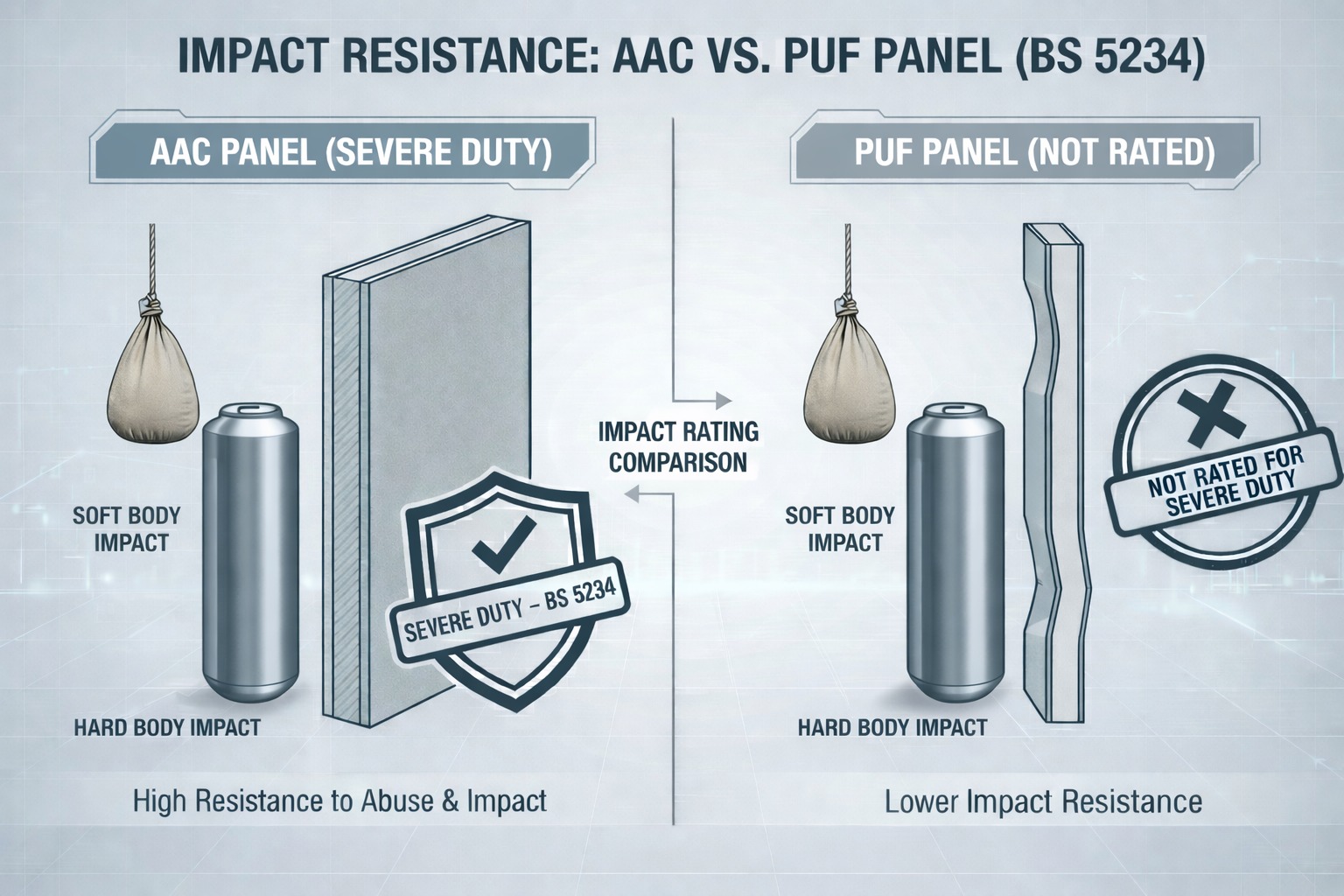
While PUF panels are susceptible to denting and surface deformation, Magicrete AAC Wall Panels are engineered to meet the most stringent international benchmarks for partition strength.
Technical Benchmark: BS 5234: Part 2:1992 This British Standard categorizes walling systems based on their ability to withstand physical impact. Magicrete AAC Wall Panels are tested for:
- Hard Body Impact: Resistance to damage from sharp objects or accidental collisions.
- Soft Body Impact: Ability to withstand the force of a person falling against the wall or equipment bumping it.
- Severe Duty (SD) Grading: Because AAC panels meet these criteria, they are classified for "Severe Duty," making them suitable for areas prone to intense traffic and prone to frequent impact.
PUF Panels: Lightweight but Mechanically Flexible
PUF panels rely on bonded metal skins for strength. While adequate for enclosure purposes, they may be susceptible to:
- Denting and surface deformation
- Reduced anchoring capacity
- Joint fatigue over time
- Flex under pressure differentials
For industrial sheds or warehouses, this may not pose a major concern. However, for high-traffic or mission-critical environments, structural rigidity becomes a decisive factor.
Insight for Developers:
Walls are not merely partitions, they support fixtures, equipment, and daily operations. Choosing a rigid system minimizes maintenance risks.
Fire Safety: A Non-Negotiable Parameter in Modern Buildings
Fire performance is increasingly influencing building approvals, insurance considerations, and occupant safety strategies.
AAC Wall Panels: Mineral-Based Fire Protection
Being composed entirely of inorganic materials, AAC panels are naturally non-combustible.
Typical advantages include:
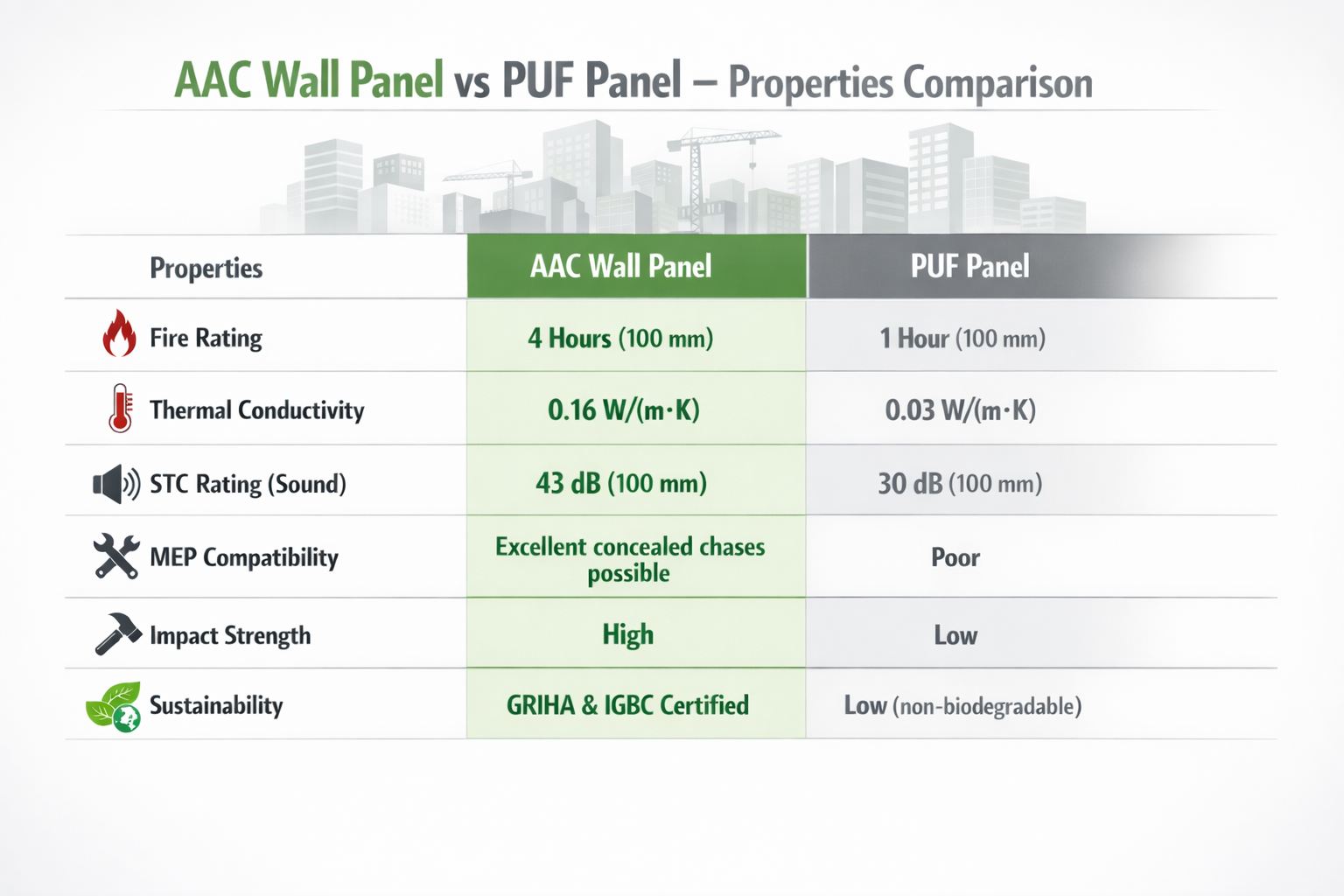
- Up to 4-hour fire rating
- No flame spread
- No toxic smoke emission
- Maintains structural integrity at high temperatures
This makes AAC an ideal choice for fire-rated wall assemblies in hospitals, high-rise towers, data centers, and hospitality projects.
PUF Panels: Polymer-Based Behavior
PUF is a petrochemical product. Although fire-retardant formulations exist (such as PIR cores), performance varies depending on manufacturing quality.
Potential concerns:
- Combustibility under extreme heat
- Smoke generation
- Dependence on additives for fire resistance
For evacuation-sensitive environments, mineral walling systems generally offer greater passive safety.
Strategic Takeaway:
When evaluating AAC Wall Panels vs PUF Sandwich Panels, fire behavior alone often tilts the decision toward AAC for permanent infrastructure.
Thermal Efficiency: Stability vs Extreme Insulation
Thermal insulation is frequently cited as the primary advantage of PUF panels, but real-world building performance depends on more than conductivity alone.
PUF Panels: High Insulation Value
With very low thermal conductivity, PUF panels excel in applications such as:
- Cold storages
- Pharmaceutical facilities
- Food processing plants
Their ability to “trap” temperature makes them indispensable in controlled environments.
AAC Wall Panels: Balanced Thermal Performance
Magicrete AAC Wall Panels typically exhibit thermal conductivity around 0.16 W/m·K, enabling them to resist heat transfer effectively while also providing thermal mass.
Unlike thin-skin systems, AAC moderates temperature fluctuations, resulting in:
- Reduced HVAC loads
- Improved indoor comfort
- Lower operational energy costs
For residential and commercial occupants, thermal stability often proves more beneficial than insulation alone.
Acoustic Comfort: The Advantage of Mass
As urban density increases, acoustic insulation has become a premium expectation rather than a luxury.
AAC Wall Panels
- STC rating of 43+
- Effective noise dampening between rooms
- Ideal for patient recovery zones, hotel rooms, and offices
PUF Panels
- Lower mass results in weaker sound insulation
- Often requires additional layers to achieve privacy standards
For developers targeting premium positioning, acoustic performance directly impacts occupant satisfaction.
Case Study: Why Structural Stiffness Matters (JJ Hospital, Mumbai)
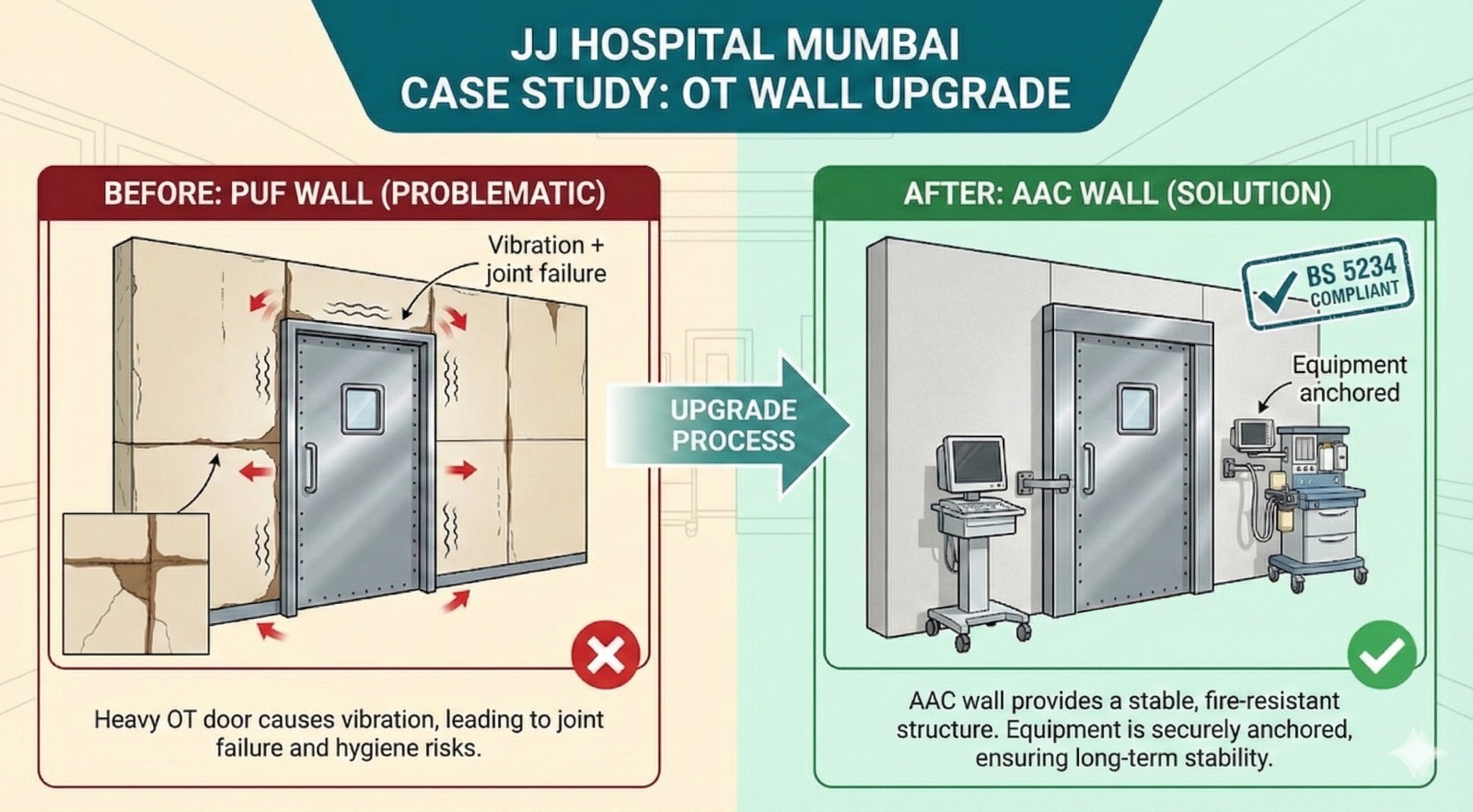
The limitations of lightweight polymer-based systems are often exposed in mission-critical environments. A landmark example is the renovation at JJ Hospital, Mumbai.
The Problem: The "Heavy Door" Syndrome
Hospital OTs require heavy, lead-lined doors that open and close hundreds of times a day. Originally, PUF panels were used for the OT walls due to their fast installation.
However, the constant mechanical vibration and the air-pressure differentials caused by the automated doors led to structural fatigue in the PUF panels. The walls began to vibrate and flex, leading to:
- Joint Failures: Compromising the airtight, sterile environment.
- Mounting Issues: Inability to securely hold heavy surgical lighting and medical gas pendants.
The Magicrete Solution with AAC Wall Panels.
The hospital replaced the PUF system with Magicrete AAC Wall Panels.
- The Result: The high density and reinforced core of the AAC panels provided the mechanical stiffness required to anchor heavy door frames and medical equipment.
- The Compliance: Meeting BS 5234 Severe Duty requirements meant the walls could absorb the energy of slamming automated doors without cracking or losing their airtight seal.
AAC Wall Panels vs PUF Panels, Developer Comparison Matrix
Feature | AAC Wall Panels | PUF Panels |
Structural Feel | Lightweight but heavy-duty | Lightweight and flexible |
Fire Safety | Non-combustible, up to 4 hours | Varies; potential smoke risk |
Thermal Behavior | Stable and balanced | Extremely high insulation |
Acoustic Control | Excellent | Moderate to low |
Lifecycle | Ideal for permanent buildings | Better for temporary structures |
Sustainability | Supports green ratings | Recycling challenges |
Ideal Applications: Why AAC Wall Panels Are the Preferred Choice Across Building Types
While multiple walling materials exist in modern construction, developers are increasingly standardizing toward AAC Wall Panels because of their ability to deliver structural reliability, fire safety, thermal stability, and acoustic comfort within a single system.
Unlike insulation-focused alternatives that are limited to niche environments, AAC panels are engineered to perform consistently across a wide spectrum of building categories.
AAC Wall Panels — A Future-Ready Solution for Nearly Every Built Environment
AAC Wall Panels are ideally suited for:
- High-rise residential developments requiring fire-rated and acoustically efficient walls
- Hospitals and healthcare facilities, where safety, hygiene, and durability are critical
- Hotels and hospitality projects demanding occupant comfort and noise control
- Commercial offices prioritizing long lifecycle performance
- Educational institutions exposed to heavy daily usage
- Retail developments and mixed-use projects
- Data centers and mission-critical infrastructure
- Industrial facilities seeking permanent, low-maintenance walling
- Warehousing and logistics parks transitioning toward durable construction
Because AAC is a reinforced mineral walling system, it supports the growing industry shift toward standardized, high-performance materials rather than project-specific compromises.
Conclusion
For any building intended for human occupancy, high-traffic, or long-term asset value, AAC Wall Panels are the only viable choice.
- Safety First: Unlike PUF, AAC is 100% non-combustible. In high-rise residential or hospital settings, choosing a polymer-based wall (PUF) over a mineral-based wall (AAC) is a significant safety compromise.
- Structural Integrity: As seen in the JJ Hospital case study, PUF panels fail under the mechanical stress of heavy doors and equipment. AAC provides the "solid-wall" feel and anchoring strength that permanent infrastructure requires.
- Acoustics & Comfort: PUF panels act like drums, amplifying noise. AAC absorbs it, providing the quiet environment essential for hotels, offices, and homes.
Build Smarter with Magicrete AAC Wall Panels
Planning a healthcare facility, high-rise project, or commercial development? Selecting the right walling solution today can significantly influence operational costs and building safety tomorrow.
Magicrete AAC Wall Panels combine the speed of precast installation with the reliability of mineral masonry, helping you build faster without compromising performance.
Build faster. Build safer. Build with Magicrete.
FAQ's
1. What is the main difference between AAC panels and PUF panels?
AAC panels are mineral-based, reinforced walling systems designed for permanent buildings, offering fire resistance, structural stiffness, and acoustic comfort. PUF panels are polymer-based sandwich panels primarily designed for insulation-driven, temperature-controlled environments.
2. Are AAC panels load-bearing?
AAC wall panels are generally used as non-load-bearing walls. However, due to their reinforced core and high stiffness, they provide superior impact resistance and anchoring strength compared to lightweight sandwich panels.
3. Do PUF panels provide better insulation than AAC panels?
PUF panels offer extremely high thermal insulation and are ideal for cold storage and pharmaceutical facilities. AAC panels provide balanced thermal performance with thermal mass, making them more suitable for residential and commercial buildings.
4. Which is better for residential buildings: AAC or PUF panels?
AAC wall panels are better suited for residential buildings due to their fire safety, acoustic insulation, durability, and long-term comfort. PUF panels are generally not recommended for permanent residential occupancy.
5. Are AAC panels and PUF panels part of modular precast construction?
Yes. Both AAC wall panels and PUF panels fall under Modern Methods of Construction (MMC). However, AAC panels are preferred for permanent modular and precast buildings, while PUF panels are typically used for temporary or specialized enclosures.
One-Stop Solution for all your Construction Needs
Contact Us