
-
Lightweight AAC Wall Panels: Types, Structural Use & Applications
-

Why Lightweight AAC Wall Panels Redefine Modern Construction?
The global construction industry is shifting towards Industrialized Building Systems (IBS). To combat rising labor costs and compressed timelines, architects and structural engineers are moving away from labor-intensive masonry in favor of AAC wall panels.
Traditionally, "precast" was synonymous with "heavy" due to the high density of standard reinforced concrete. However, AAC (Autoclaved Aerated Concrete) technology has revolutionized this by utilising a unique chemical expansion process. By introducing an aerating agent into the mix, millions of tiny hydrogen bubbles create a cellular structure that reduces mass by nearly 75%. When cured under high-pressure steam in an autoclave, these panels achieve a high strength-to-weight ratio, allowing for rapid assembly without the logistical burden of heavy-duty precast components.
For industry professionals, this low-density AAC technology is not just a material choice; it is a strategic tool to optimise structural design. By significantly lowering the building's total dead load, engineers can reduce foundation requirements and structural steel. This makes it an essential solution for managing compressed project timelines, meeting stringent thermal and fire-safety regulations, and lowering the overall cost of construction — especially when compared with other modern walling systems in India.
What Are Lightweight AAC Wall Panels?
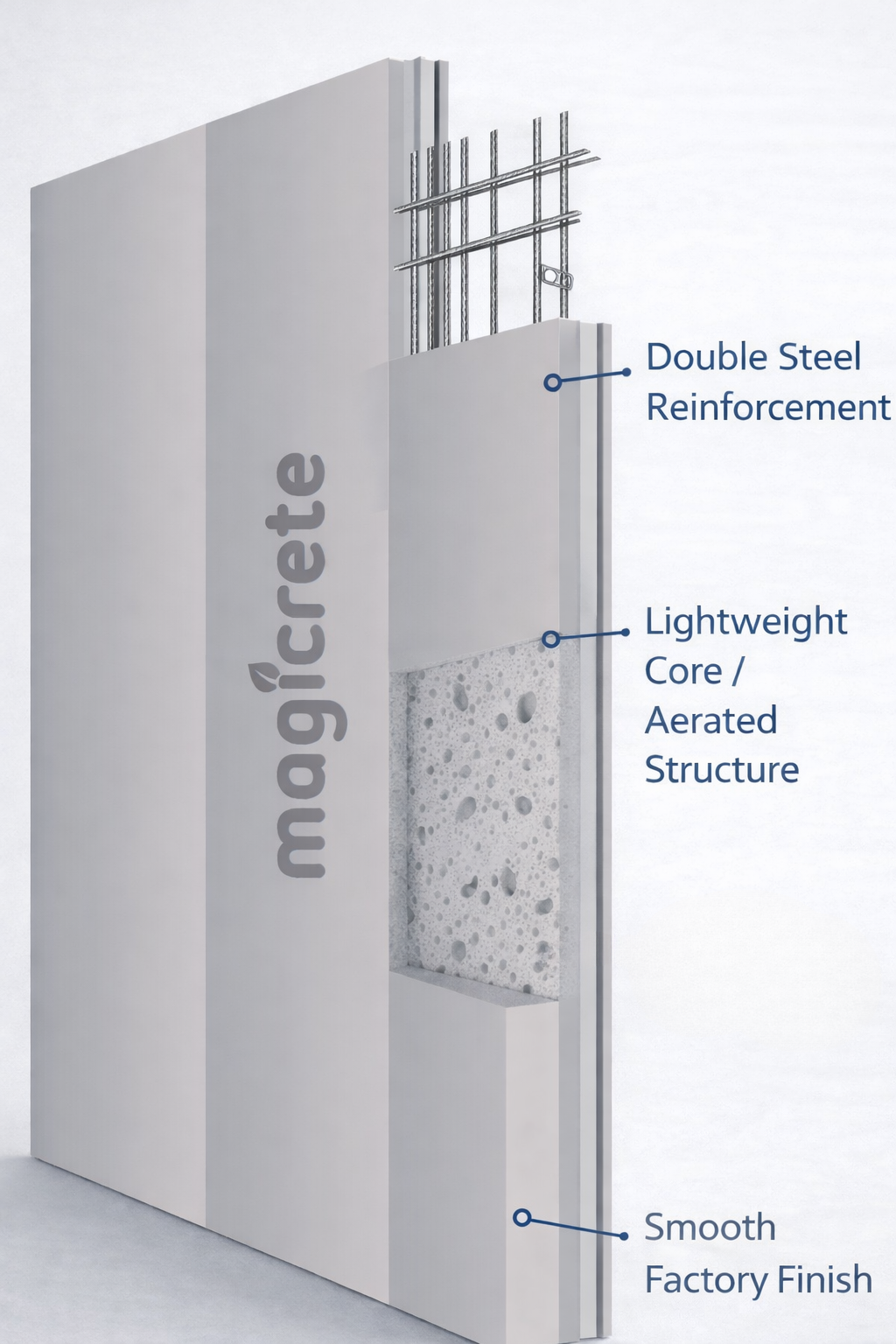
Lightweight AAC wall panels are factory-manufactured building components designed to replace traditional brick-and-mortar or heavy cast-in-situ concrete walls.
How Do They Differ from Conventional Precast?
Unlike standard concrete wall panels, which can be cumbersome and require heavy-duty lifting equipment, lightweight variants utilize sand, cement, lime and aerating agent to reduce density without sacrificing strength.
Key Characteristics:
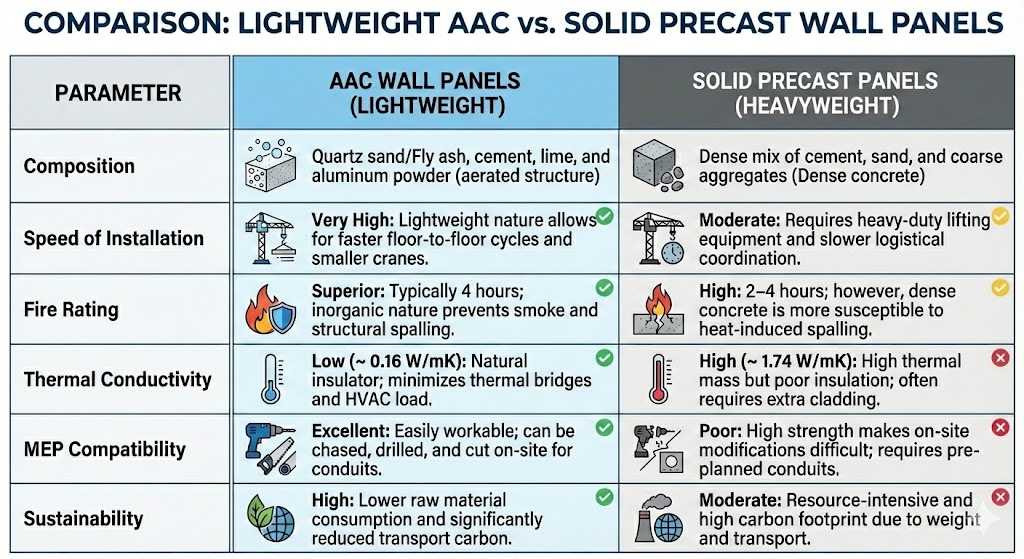
Ultra-Low Density: At ~650 kg/m³, AAC is roughly1/4th the weight of solid concrete, drastically reducing the building’s dead load and foundation costs.
Thermal Insulation: AAC is a natural insulator (~0.16 W/mK), reducing HVAC energy loads by up to 30%, as explained in our detailed guide on the thermal insulation benefits of AAC blocks in Indian climates.
Fire Safety: AAC is inorganic and non-combustible, providing a4-hour fire rating without the "spalling" (cracking) risks associated with dense concrete.
Site Efficiency: Tongue and groove engineered for "plug-and-play" installation.
Why Lightweight Matters in Modern Construction?
For structural engineers and developers, the weight of a building’s envelope is a critical variable that impacts the entire construction ecosystem:
Reduced Foundation Costs: Lower dead loads reduce stress on the structural frame, often allowing for more slender columns or fewer piles.
Logistical Efficiency: More panels can be transported per truckload, reducing carbon footprints and logistics costs.
Lower Crane Dependency: Lighter panels can be installed using smaller, more affordable cranes, crucial for tight urban sites.
Seismic Performance: In regions like India, reduced mass significantly lowers the inertial forces acting on a building during an earthquake.
Types of Wall Panels
1. AAC Wall Panels
Autoclaved Aerated Concrete (AAC) wall panels are solid, steel-reinforced inorganic slabs. Unlike other lightweight options, AAC provides a unique combination of structural robustness and thermal insulation. Because they are autoclaved, they have negligible drying shrinkage and offer a 4-hour fire rating, making them the gold standard for both internal partitions and external cladding.
2. Solid Concrete Precast Panels
These are traditional dense concrete panels (2400kg/m³). While they offer the highest impact resistance and structural load-bearing capacity, they are extremely heavy, requiring massive foundations and heavy-duty cranes for installation. They lack the thermal insulation properties of AAC and add significant dead load to the building frame.
3. PUF (Polyurethane Foam) Panels
These consist of a foam core sandwiched between metal sheets. Primarily used for cold storage or temporary sheds, they offer high thermal resistance but fail in terms of "solid wall" feel, acoustic damping, and fire propagation limits required for residential or commercial high-rises.
4. EPS (Expanded Polystyrene) Sandwich Panels
These utilize a thermocol-based core encased in fiber cement skins. While light, they are prone to internal delamination and do not offer the same high-temperature stability or breathability as the inorganic cellular structure of AAC.
5. Drywall Systems (Gypsum/Fiber Cement)
Drywalls use a metal stud frame with board linings. While fast, they are hollow systems with poor impact resistance. Unlike AAC panels, they are strictly non-load-bearing and require extensive secondary framing to support heavy wall-mounted fixtures.
Structural Role and Interaction
Infill vs. Load-Bearing Applications
In modern high-rise construction, AAC wall panels function as a high-performance infill system or "skin." They are non-load-bearing regarding the building’s primary vertical loads; the RCC or steel frame (the skeleton) carries the weight of the slabs and occupancy. However, in specifically designed low-rise modular structures (up to G+2), AAC panels can be engineered to act as load-bearing walls that distribute vertical loads to the foundation.
Performance Under Lateral and Environmental Loads
While they do not carry the building's weight, AAC panels are engineered to be structurally active in other ways:
Wind & Seismic Loads: Panels are designed to withstand lateral wind pressures and seismic inertial forces.
Structural Integration: Using specialized mechanical connectors (L-clips/Z-brackets), the panels are tied to the primary frame - a process covered step-by-step in our AAC wall panel installation guide. These connections are designed to accommodate inter-story drift, ensuring the walls do not crack when the building frame sways.
Comparison: Lightweight AAC Wall Panels vs. Solid Precast Panels
Applications Across Building Types
1. Residential & Affordable Housing
In large-scale residential projects, the speed of the "dry construction" method is a major profitability driver.
Precision & Speed: The large format of AAC panels replaces dozens of individual blocks, allowing for rapid floor-to-floor cycles.
Increased Carpet Area: Thinner AAC panels can often provide the same thermal and acoustic insulation as thicker traditional brick walls, effectively increasing the usable carpet area for homeowners.
2. Commercial & Office Spaces
Modern high-rises require high-performance building envelopes that can withstand wind loads while remaining lightweight.
Internal Partitions: Used for rapid internal cabin and corridor partitioning with superior acoustic privacy (high STC ratings).
Weight Reduction: By using AAC panels for non-load-bearing infill and core walls, developers can significantly reduce the total tonnage of the building, leading to leaner structural frames.
3. Industrial & Warehousing
Industrial facilities have stringent safety and insulation requirements.
Fire-Rated Boundary Walls: AAC is inorganic and non-combustible. AAC panels are widely used to create fire-compartmentalization walls that can offer up to a 4-hour fire rating, especially in projects highlighted in our blog on where to use AAC wall panels.
Thermal Regulation: For warehouses storing temperature-sensitive goods, the low thermal conductivity of AAC reduces the energy load required for HVAC systems.
4. Healthcare & Hospitality
These sectors prioritize hygiene, acoustics, and minimal downtime.
Dry Construction: Unlike traditional masonry, AAC panel installation involves minimal water usage and zero debris, making it ideal for hospital expansions or hotel renovations where cleanliness is critical.
Acoustic Comfort: The cellular structure of AAC naturally dampens sound, ensuring quiet environments in patient rooms and guest suites.
Key Design & Installation Considerations
Successful implementation requires specific attention to AAC's material properties:
Structural Movement Joints: Design flexible "soft joints" at the panel head and sides using compressible filler and sealants. This decouples the infill wall from the frame, allowing for inter-story drift without cracking the panels.
MEP Integration: Unlike dense precast, conduits do not need to be pre-cast. Plan conduit routes for easy on-site chasing, taking advantage of AAC's high workability using standard chase cutters.
Finishing & Waterproofing: Due to AAC's porosity, specify a proprietary thin-bed joint adhesive and a breathable external render system to ensure a watertight yet vapor-permeable envelope.
Common Myths About Lightweight Precast
"Lightweight means weak": False. Advanced curing and reinforcement allow these panels to exceed the compressive strength of traditional masonry.
"Only for low-rise buildings": Modern precast is used globally in skyscrapers and heavy infrastructure.
"Too expensive": When factoring in reduced labor and faster project handover, it is highly cost-competitive.
The Core of Modular Construction
Lightweight AAC wall panels address the industry’s most pressing challenges: speed, quality, and scalability. As construction moves decisively toward industrialized and modular systems, these panels are no longer optional, they are foundational.
Are you planning your next high-rise or industrial project?
Contact our technical team today to get a detailed quote on wall panel price options and discover how our AAC wall panels can optimize your structural design.
FAQs
1. What are lightweight AAC wall panels?
Factory-manufactured wall elements designed to reduce structural weight while maintaining high-performance standards.
2. Are lightweight AAC wall panels load-bearing?
They are primarily used asnon-load-bearing infillin multi-story framed buildings. However, for specific low-rise modular structures (typically up to G+2), reinforced AAC panels can be engineered to function asload-bearing walls.
3. How are lightweight AAC wall panels different from AAC block walls?
A panel is a large-format, floor-to-ceiling unit. It replaces dozens of individual blocks, reducing joints, increasing speed, and providing higher structural integration.
4. Are they suitable for Indian construction conditions?
Yes. They are engineered to handle India's seismic zones and provide the thermal insulation necessary for its varied climate.
5. Why are they preferred in modular construction?
Because they enable precision manufacturing, repeatable quality, and a "factory-to-site" workflow that significantly reduces on-site variability.
One-Stop Solution for all your Construction Needs
Contact Us