
-
Traditional Construction vs. Precast Construction: Time, Cost & Quality Comparison
-

Introduction
In the modern AEC (Architecture, Engineering and Construction) sector, the pressure to deliver projects faster, more economically and with higher precision has never been greater. For architects, builders and civil engineers, the choice of methodology is no longer just a technical preference,it is a strategic business decision that defines a project’s success or failure.
While traditional construction has served as the industry backbone for centuries, it is increasingly viewed as a high-risk approach in a fast-paced market. Modern construction techniques, specifically Precast systems, are disrupting the status quo by treating buildings as engineered products rather than unpredictable site-based projects. Industry leaders like Magicrete are at the forefront of this shift, providing the technology and precision needed to move from "building" to "assembling."
How Traditional Construction Works: The Legacy of Site-Driven Execution
Traditional construction, or "cast-in-situ," is characterized by a sequential, linear workflow where almost every variable, from weather to labor skill, is outside the developer's total control.
Step-by-Step Dependencies: Foundations must be fully cured before the superstructure begins. This creates a "waiting game" that stretches timelines.
Heavy Labour Dependence: Success is tethered to the fluctuating availability and skill levels of local masonry and RCC teams.
Progressive Quality Risks: Structural errors like weak concrete or crooked walls are often only found after the concrete has hardened. Since you can’t undo a concrete pour, fixing these mistakes requires expensive, time-consuming demolition.
How Precast Construction Works: The System-Led Future
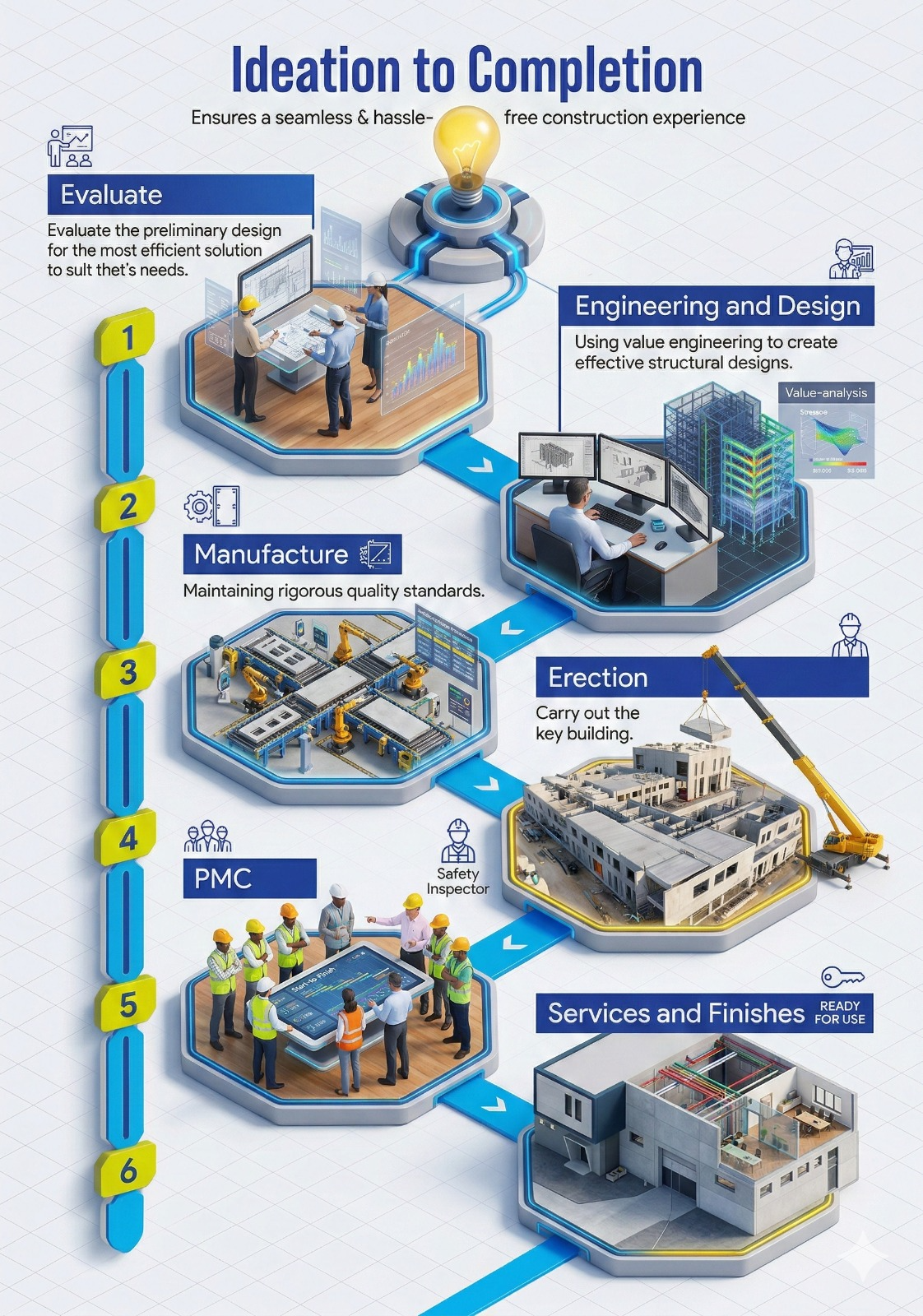
Precast streamlines the construction journey through a high-efficiency, six-phase "Ideation to Completion" process that eliminates the vendor coordination challenges of traditional methods.
Evaluate: It assess preliminary designs to identify the most efficient structural solutions tailored to specific client needs.
Engineering and Design: Precast uses value engineering to create structural designs optimized for maximum strength and material efficiency.
Manufacture: Components are produced in a controlled factory environment to maintain rigorous quality standards and strict production schedules.
Erection: Complete on-site assembly, rapidly transforming foundations into standing structures.
PMC (Project Management Consultancy): Dedicated professionals monitor and control the project from start to finish to ensure timeline and budget predictability.
Services & Finishes: Delivers complete building services and finishing works, resulting in a fully finished, ready-to-use precast structure.
Key Difference: Process Thinking vs. System Thinking
The shift to Precast is a shift in mindset:
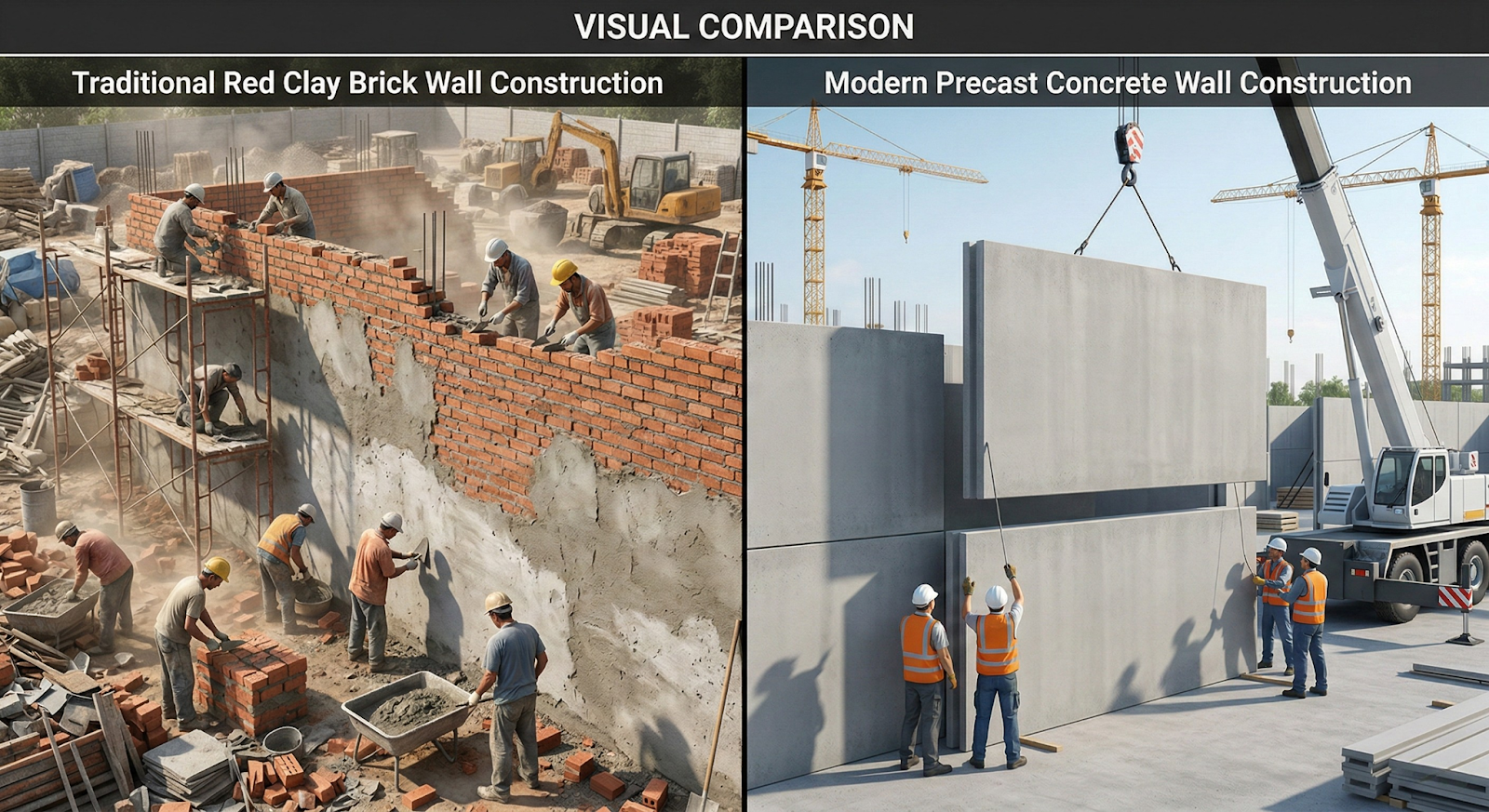
- Traditional = Process-Driven: A chain of dependent trades where one delay (e.g., a monsoon or labor strike) halts the entire project.
- Precast = System-Driven: The building is a "system of parts." Predictability is the priority. By using standardized components from specialized manufacturers like Magicrete, builders decouple the project from environmental and labor variables.
Time Comparison: Why Precast Wins on Speed
Traditional Construction Timelines
Sequential dependencies create a "cumulative delay" effect. Finishing activities, such as plastering and electrical work, must wait for "wet work" to cure and dry. This leads to a trades "logjam" in the final months, often pushing handover dates by 20-30%.
Precast Construction Timelines
Precast offers a massive time advantage. Buildings achieve "enclosure" (dry-in) months ahead of schedule, allowing internal finishing to happen in a protected environment. On average, Precast systems reduce total project duration by 30-50%.
Cost Comparison: Beyond the Initial Quote
When comparing costs, architects and engineers must focus on cost certainty and lifecycle value rather than just the initial price per square foot.
Feature | Traditional Construction | Precast Construction (Magicrete Standard) |
Material Wastage | High (10-12% on-site) | Minimal (<2% in-factory) |
Labour Costs | Variable; high headcount | Fixed; low headcount, high skill |
Rework Risk | High (human error) | Near-zero (precision molds) |
Financial Risk | High budget volatility | High cost predictability |
While Precast requires higher upfront logistics, the ROI is achieved through earlier occupancy, reduced interest on construction loans and significantly lower on-site overheads.
Quality Comparison: Consistency vs. Craft Dependency
The Precision of Factory-Controlled Production
In a Magicrete factory, concrete is cured under optimal, standardized conditions. The result is "Fair-faced concrete", a superior finish that often eliminates the need for internal plastering. Dimensional accuracy is measured in millimeters, ensuring that every Precast panel fits perfectly with the next.
The Inconsistency of On-Site Workmanship
Traditional quality is "craft-dependent”. It varies based on the weather, the supervisor’s and the laborer's skill. This often leads to "honeycombing" in concrete and long "snag lists" during the handover phase.
The Shift to Assembling Success
The construction industry is evolving from "building on-site" to "assembling systems." Project outcomes are no longer left to chance; they are decided in the pre-construction phase.
By adopting Modern construction philosophies and partnering with experts like Magicrete, architects and builders can reclaim control over their timelines, quality and costs. The choice of execution today will define the structural integrity and maintenance profile of the building for the next fifty years.
Ready to modernize your project execution?
Contact the Magicrete technical team today to see how our Precast systems can optimize your next high-scale development.
FAQs
1. Is precast construction faster than traditional construction?
Yes. By using parallel workflows (manufacturing while excavating), Precast typically reduces project timelines by 30-50%.
2. Which method offers better quality control?
Precast. Factory-controlled production ensures consistent curing and millimeter-level accuracy, which is impossible to achieve manually on-site.
3. Does Precast help in reducing labor issues?
Significantly. Precast requires a much smaller, more highly skilled on-site team, reducing the risks associated with managing large unskilled labor forces.
4. Is Precast suitable for Indian conditions?
Absolutely. It is the gold standard for India’s rapid urbanization and is the primary choice for modern metro rails and mega-housing projects.
5. Can I use different materials like AAC panels with Precast?
Yes. Modern systems from providers like Magicrete are designed to integrate with high-performance materials like AAC and insulated panels to enhance thermal efficiency.
One-Stop Solution for all your Construction Needs
Contact Us