
-
The Science Behind Water-Resistant Tile Adhesives in Bathrooms
-

The Science Behind Water-Resistant Tile Adhesives in Bathrooms
Bathrooms, showers and wet utility areas are among the most demanding zones in any building. Constant exposure to water, humidity, cleaning chemicals and temperature variation makes tile installation here very different from dry areas such as living rooms or bedrooms.
For architects, builders, and civil engineers, selecting the right tile adhesive for wet environments is crucial in ensuring durability, safety, and long-term performance, making tile adhesive selection and performance a critical consideration in modern construction.
In this blog, we clarify what makes tile adhesives water-resistant, how to select the correct grade for bathrooms and wet areas, and why high-performance polymer-modified adhesives are essential for reliable tile installation in moisture-prone conditions.
What Is Water-Resistant Tile Adhesive?
Tile adhesives used in bathrooms and wet areas are water-resistant, not waterproof. A water-resistant tile adhesive is a polymer-modified cementitious adhesive designed to withstand moisture exposure without losing bond strength or structural integrity.
These adhesives are formulated to perform even when:
- Water penetrates grout joints
- Moisture accumulates behind tiles
- Surfaces remain damp for prolonged periods
Unlike cement-based mortars, water-resistant adhesives are engineered to maintain adhesion and flexibility under wet conditions, highlighting the difference between cement and tile adhesive in moisture-prone applications commonly found in bathrooms, showers, balconies and utility areas.
Water-resistant tile adhesives are designed to:
- Resist moisture penetration
- Maintain adequate wet bond strength
- Reduce the risk of tile debonding and hollowness
- Perform reliably in internal wet areas
Water-Resistant vs Conventional Tile Adhesive
Not all tile adhesives can tolerate moisture. Understanding the difference between water-resistant and ordinary cement-based adhesives is critical for wet-area applications.
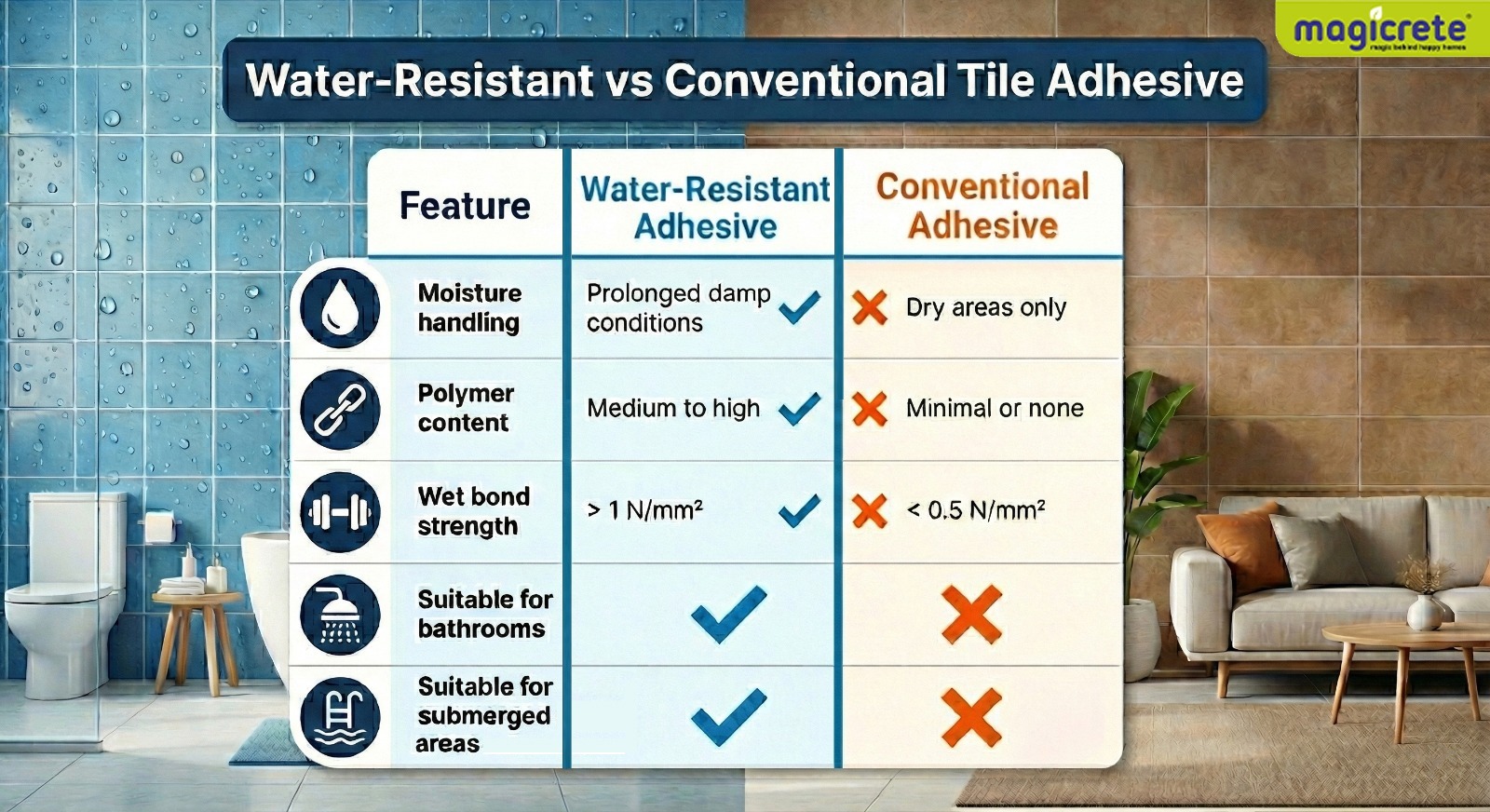
For shower floors, niches and areas exposed to frequent water contact, only high-performance water-resistant adhesives should be specified, always in combination with a proper waterproofing system.
Why Are Bathroom & Wet-Area Conditions Different?
Bathrooms are chemically and mechanically aggressive environments. Typical challenges include:
- Constant humidity
- Water seepage through grout joints
- Thermal expansion due to hot and cold water cycles
- Alkalinity from soaps, shampoos and cleaning agents
- Standing water in shower trays
- Vapor pressure buildup behind tiles
Under these conditions, standard adhesives gradually lose strength.
Polymer-modified C2 and flexible S1 adhesives are specifically designed to tolerate moisture, movement, and stress without premature failure, as defined under Tile Adhesive classifications used in Indian construction.
Technical Components That Make Tile Adhesives Water-Resistant
1. Polymer Modification (Primary Moisture Resistance Mechanism)
Polymers such as EVA, PVA, PE, styrene acrylics, or latex-based additives are blended into cement-based adhesives.
How polymers improve moisture resistance:
- During curing, polymers form a continuous film within the adhesive matrix
- This film restricts micro water pathways
- Enhances flexibility and adhesion to low-absorption tiles
This polymer network allows the adhesive to retain bonding strength even under damp conditions, something plain cement mortar cannot achieve.
2. Reduced Porosity
High-quality water-resistant adhesives are engineered with:
- Optimized particle size distribution
- Controlled cement hydration
This results in lower capillary absorption, significantly reducing moisture migration behind tiles.
3. High Wet Bond Strength
Wet bond strength indicates how well tiles remain bonded when exposed to moisture.
- Recommended benchmark for bathrooms:> 1 N/mm²
- Critical for shower walls, shower floors and wet utility areas
Low wet bond strength leads to tile popping, cracked grout and eventual leakage-related failures.
4. Slip & Sag Resistance in Vertical Wet Areas
Bathroom walls, shower niches and decorative tile installations require adhesives with:
- High thixotropy
- Anti-sag properties
These characteristics ensure tiles stay in position during installation, even on vertical surfaces.
5. Compatibility With Waterproofing Membranes
While tile adhesives are water-resistant, waterproofing membranes are still mandatory in wet areas.
The adhesive must bond effectively over:
- Acrylic liquid-applied membranes
- Polyurethane (PU) membranes
- Cementitious waterproof coatings
System compatibility between waterproofing and adhesive layers is essential for long-term performance.
How to Choose the Right Water-Resistant Tile Adhesive?
Step 1: Identify Area Type
- Wet (bathroom walls)
- Damp (utility spaces)
- High-moisture (showers)
Step 2: Evaluate Tile Type & Size
Larger and denser tiles require higher polymer content.
Step 3: Ensure Waterproofing Compatibility
Adhesive must bond securely over the chosen membrane.
Step 4: Confirm C2 / S1 / S2 Classification
Match adhesive performance to exposure conditions.
Step 5: Review Manufacturer Technical Data
Coverage, mixing ratios, open time and bond strength are critical.
Common Mistakes That Cause Bathroom Tile Failures
- Using basic C1 adhesives in wet areas
- Skipping waterproofing membranes
- Poor adhesive coverage leading to hollow tiles
- Selecting low-polymer, low-performance adhesives
- Adding excess water during mixing
Each of these errors significantly compromises long-term durability, often resulting from common mistakes to avoid when applying tile adhesive in wet areas.
Real-Life Application Insight
Across residential and commercial bathroom projects, failures such as tile debonding and grout cracking are commonly traced back to incorrect adhesive selection. Projects that adopt C2 + S1 water-resistant adhesives, along with proper waterproofing systems, consistently demonstrate:
- Significantly lower failure rates
- Faster installation cycles
- Reduced maintenance over the building lifecycle
This reinforces the importance of a system-based approach to wet-area tiling.
Key takeaways:
- Tile adhesives are water-resistant, not waterproof
- Bathrooms require C2 polymer-modified adhesives
- High-stress wet areas perform best with C2 + S1
- Specialized applications may require C2 + S2
When combined with proper waterproofing systems and correct installation practices, water-resistant tile adhesives ensure durable, safe and long-lasting tile adhesive performance in bathrooms.
FAQs
Are tile adhesives waterproof?
While high-quality tile adhesives are water-resistant (meaning they won't lose strength when damp), they are not a substitute for a waterproofing membrane. For a leak-proof installation, adhesives must be used as part of a system that includes a dedicated waterproofing layer to protect the substrate.
Can normal tile adhesive be used in bathrooms?
Standard adhesives (Type 1) are suitable for dry areas or "splash zones." However, for "wet zones" like shower floors and internal walls, it is essential to use a Type 2 or higher polymer-modified adhesive. These are specifically engineered to withstand constant moisture and prevent tile debonding.
Can water-resistant adhesive replace waterproofing?
No. Waterproofing and tile adhesives serve two distinct roles. A waterproofing membrane creates an impermeable barrier to protect the structure from seepage, while the adhesive ensures a permanent bond between the tile and that barrier. For long-term durability, they must be used together.
What adhesive is best for shower walls?
For shower walls, especially with large-format tiles, a Class C2 (Improved) and S1 (Deformable) polymer-modified adhesive is recommended. This provides the high bond strength needed for vertical applications and the flexibility to absorb thermal expansion and contraction caused by hot water.
Do vitrified tiles require water-resistant adhesive?
Yes. Because vitrified tiles have an extremely low water absorption rate (often <0.5%), they cannot form a mechanical bond like traditional ceramic tiles. They require high-performance, polymer-modified adhesives that create a chemical bond to ensure the tiles remain secure in wet environments.
One-Stop Solution for all your Construction Needs
Contact Us