
-
Tile Adhesive Classifications Explained: A Technical Guide for Modern Indian Construction
-

Introduction
Tile failures are rarely caused by tiles alone. In most cases, the root cause lies beneath in the wrong tile adhesive selection.
With India’s rapid shift toward vitrified tiles, large-format tiles, thin porcelain slabs and high-rise construction, understanding tile adhesive classifications (C1, C2, S1, S2) and the applications, types and performance of tile adhesives is no longer optional. These standards exist for a reason: to match tile type, substrate and environment, not just to “stick” a tile.
Before diving into detailed classifications, let’s first understand what these standards actually mean.
At a basic level:
- C1 and C2 define bond strength and performance level
- S1 and S2 define flexibility (deformability)
Together, they determine whether a tile installation will last for decades, or fail within months.
Why Tile Adhesive Classifications Matter Today?
India’s construction landscape has changed dramatically in the last decade:
- Aggressive shift to vitrified & large-format tiles with near-zero porosity
- Uneven substrate quality across RCC slabs, screed, plaster and AAC
- High thermal expansion on terraces, balconies and facades
- Slab vibration in high-rise buildings
- Sharp moisture variation between internal and external spaces.
The result?
A tile adhesive must be selected based on tile + substrate + environment, not just bond strength alone, which is why understanding how to choose the right tile adhesive is critical.
This is exactly where EN 12004 tile adhesive classification becomes critical.
Understanding EN 12004 Tile Adhesive Classification
Cementitious Adhesives (C) – The Core Category Used in India
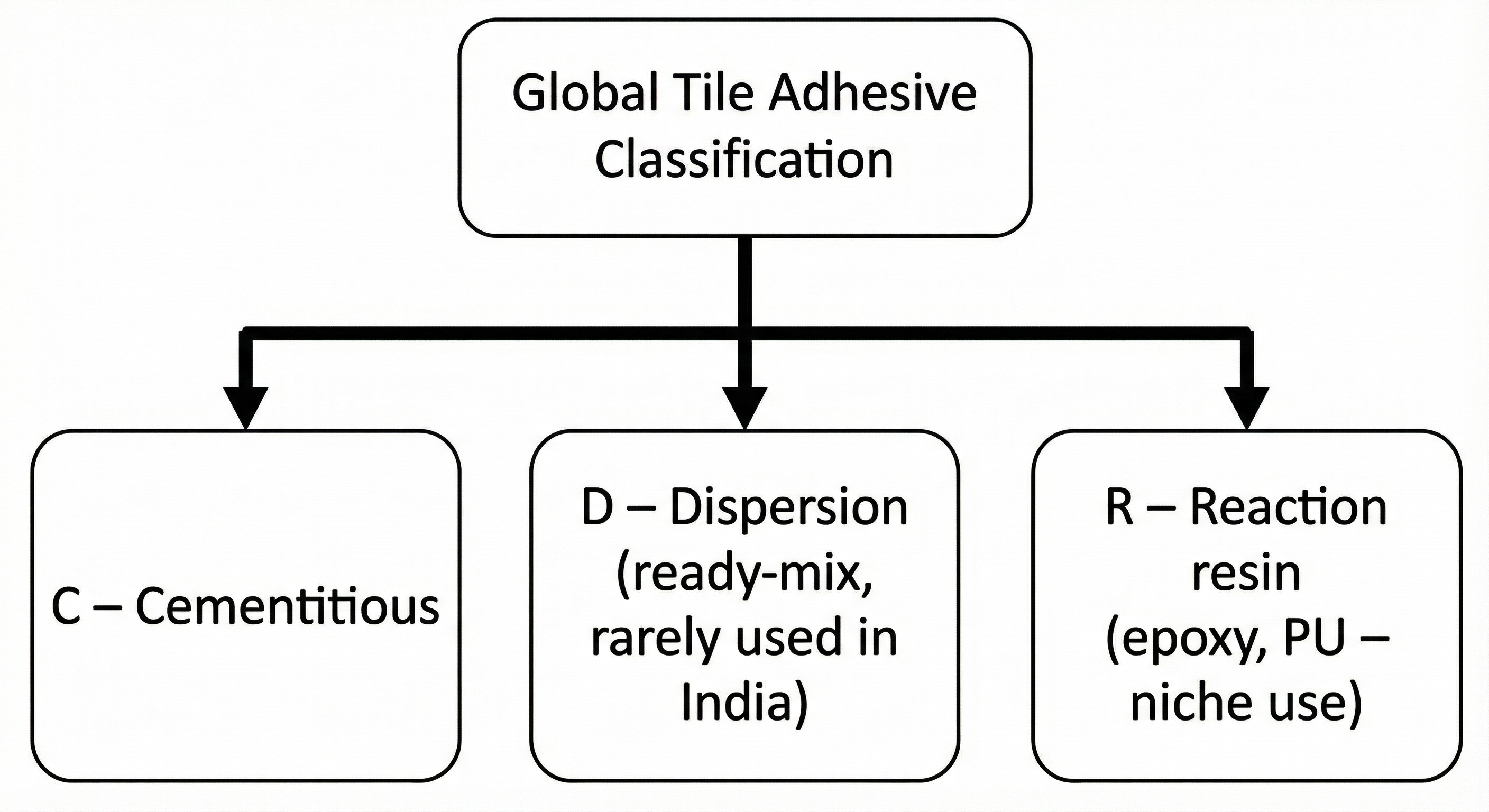 In India, cementitious tile adhesives (C) dominate due to site conditions, tile sizes and cost practicality. Hence, C-based classifications are the most relevant.
Performance Modifiers (T, E, F) – Control Behaviour, Not Strength
These letters define how an adhesive behaves during application:
- T (Slip Resistance) – Prevents tiles from sliding on walls
- E (Extended Open Time) – Allows longer working time
- F (Fast Setting) – For rapid installations
Example: C2TE means high-performance adhesive with slip resistance and extended open time.
Deformability Classes (S1, S2) – The Real Game Changer
This is where most tile failures are prevented, or caused.
- S1 – Deformable (flexible)
- S2 – Highly deformable (very flexible)
These grades absorb movement, not just hold tiles.
C1 vs C2 Tile Adhesives: What’s the Real Difference?
At a glance, C1 and C2 tile adhesives may look similar, they are both cementitious and mixed with water on site. However, their internal chemistry, bonding mechanism and real-world performance are fundamentally different. Understanding this difference is critical, especially with today’s low-porosity tiles.
C1 vs C2: Technical Comparison Table
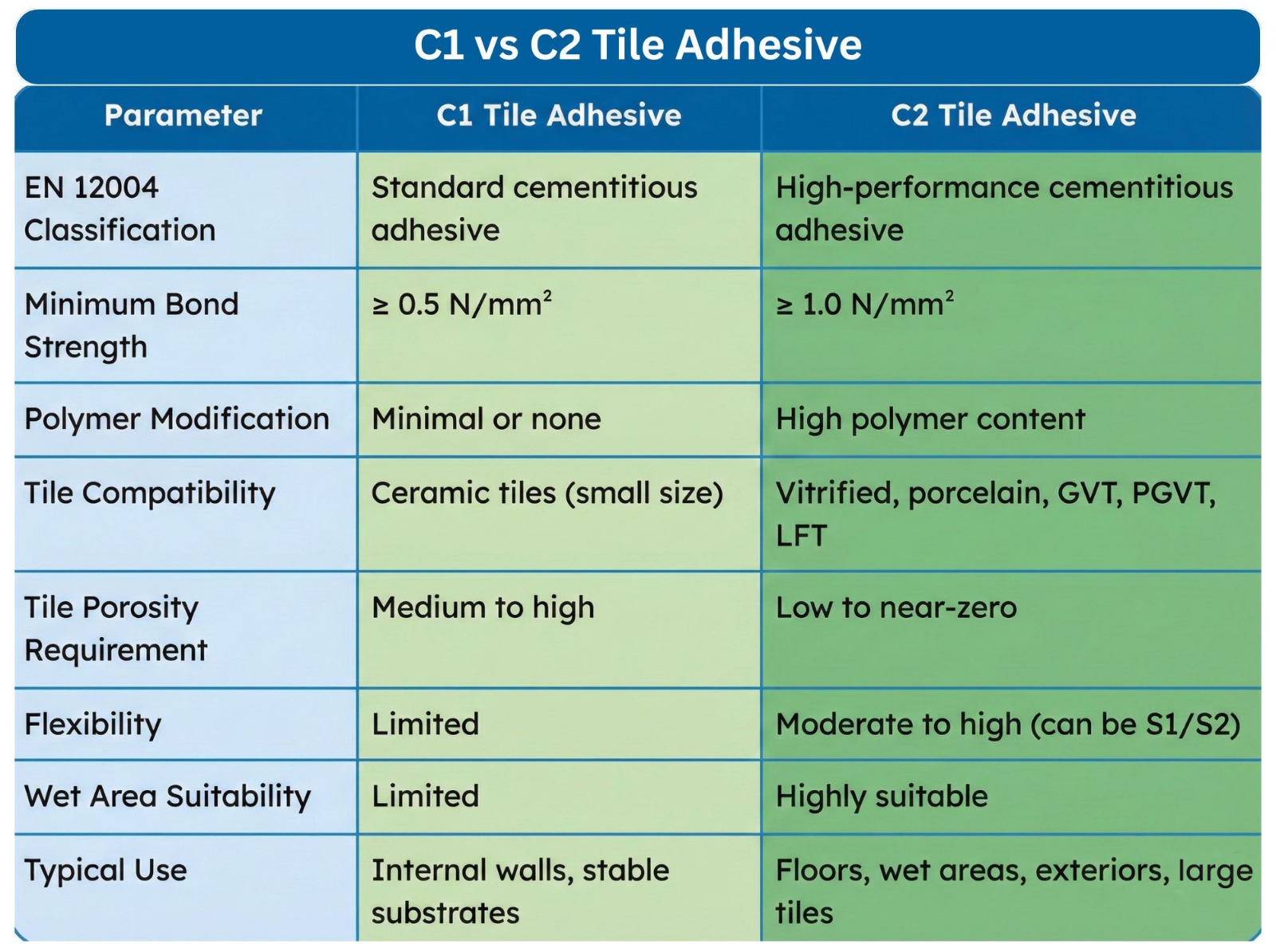
Understanding C1 Tile Adhesive in Today’s Context
C1 tile adhesives were developed during a time when ceramic tiles dominated the market. These tiles had higher water absorption, allowing cement hydration to occur effectively. As long as the substrate was stable and the tile size was small, C1 adhesives performed reliably.
However, modern construction has moved away from absorbent tiles. Today’s vitrified and porcelain tiles absorb less than 0.5% water, which directly affects cement hydration. Since C1 adhesives rely largely on mechanical bonding through cement hydration, which explains the difference between cement and tile adhesive in modern tile installations, they struggle to form a durable bond on low-porosity tile backs.
This scientific mismatch, not poor workmanship, is the primary reason C1 adhesives fail when used with vitrified tiles.
Why C2 Adhesives Are Essential for Modern Tiles?
C2 tile adhesives are polymer-modified systems engineered specifically to address low-porosity tiles and dynamic site conditions. Instead of relying only on cement hydration, polymers create chemical adhesion between the tile and substrate.
This allows C2 adhesives to:
- Bond effectively to vitrified, porcelain and large-format tiles
- Maintain adhesion even when tile backs do not absorb water
- Perform reliably in wet areas and exterior environments when used with water-resistant tile adhesives designed for moisture-prone conditions
- Work in combination with flexibility classes like S1 and S2
In simple terms, C2 adhesives do not depend on tile absorption to perform, which makes them indispensable for today’s tile formats.
Where C1 Stops and C2 Becomes Mandatory.
Large-format and vitrified tiles are dense and non-porous; in such cases, the stress on the adhesive layer rises exponentially. This is why C2 adhesives are not an upgrade, but a requirement for:
- Vitrified and porcelain tiles
- GVT and PGVT surfaces
- Large-format tiles (600×1200, 800×1600)
- Slab tiles (4×2, 2×4, 5×10 ft)
- Bathrooms, kitchens and wet areas
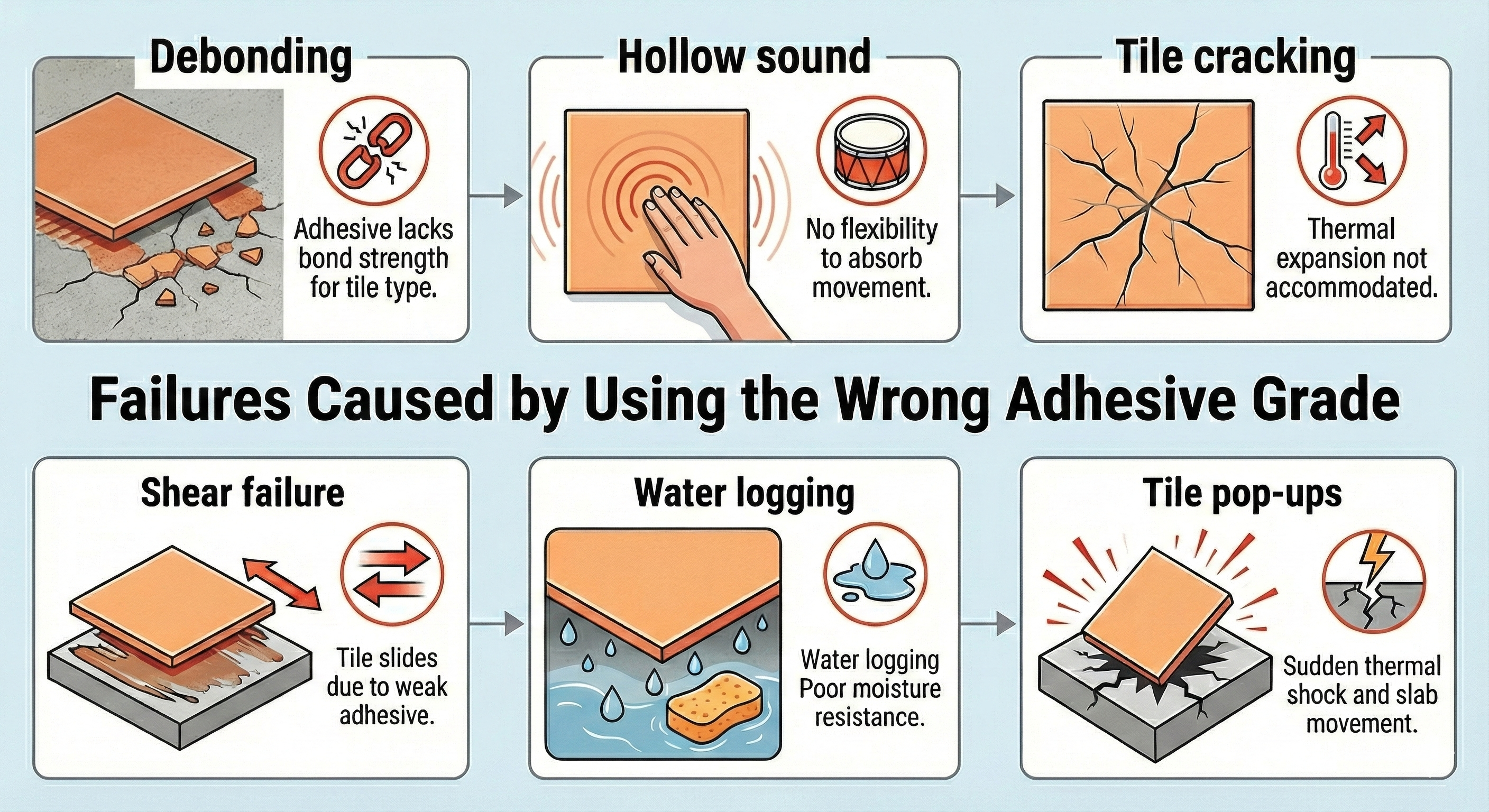
In these applications, using C1 adhesive introduces a high risk of debonding, hollow sound and tile pop-ups.
Failures caused by using the wrong adhesive grade are among the most common tile adhesive application mistakes seen in modern construction.
- Debonding: Adhesive lacks bond strength for tile type
- Hollow sound: No flexibility to absorb movement
- Tile cracking: Thermal expansion not accommodated
- Shear failure: Tile slides due to weak adhesive
- Water logging: Poor moisture resistance
- Tile pop-ups: Sudden thermal shock and slab movement
Each failure traces back to incorrect grade selection.
Adhesive Grade Is Engineering, Not Guesswork
Tile adhesives are no longer commodity materials. They are engineering products designed to work with modern tiles, substrates and environments.
Understanding C1, C2, S1 and S2 classifications empowers homeowners, contractors and designers to make technically correct decisions, Preventing failures, saving costs and ensuring long-lasting tile installations through correct adhesive grade selection. Choosing the right grade is not about price, it’s about performance matching.
Magicrete Tile Adhesives Aligned with EN 12004 Classifications
To support correct grade selection in line with EN 12004, Magicrete offers a comprehensive tile adhesive portfolio covering C1T, C2TE, C2TE S1 and reactive resin (R2T) systems. The range is designed to address the full spectrum of modern tile installations, from standard ceramic tiles on stable internal substrates to vitrified, large-format and natural stone applications subjected to movement, moisture and thermal stress.
Magicrete polymer-modified C2 and C2TE adhesives are engineered for low-porosity tiles and extended workability, while C2TE S1 solutions provide controlled deformability to absorb structural and thermal movement in balconies, terraces and high-stress zones. For complex substrates and critical applications, R2T reactive resin adhesives offer high bond strength, chemical resistance and flexibility, making them suitable for metal, epoxy-coated, drywall and non-absorbent surfaces.
This classification-aligned product approach ensures that adhesive selection is driven by tile type, substrate behavior and site conditions, not by convention—reducing failure risks and ensuring long-term performance.
FAQ's
What is the difference between C1 and C2 tile adhesive?
C2 has double the bond strength and polymer modification, making it suitable for vitrified and large tiles.
When should I use S1 grade adhesive?
For large-format tiles, balconies and areas with structural movement.
Do large-format tiles always need S1 or S2?
Yes. Tile size increases stress, flexibility becomes essential.
Is C1 suitable for vitrified tiles?
No. Vitrified tiles require polymer-modified C2 adhesives.
Which adhesive is best for bathroom floors?
C2T or C2TE depending on tile size.
What does “TE” mean in C2TE?
T = Slip resistance, E = Extended open time.
Can S1 reduce tile popping?
Yes, by absorbing thermal and structural movement.
What is the best adhesive for 4×2 ft tiles?
C2 with S1 flexibility.
Does polymer content decide C2 grade?
Yes. Polymer modification is essential to achieve C2 performance.
One-Stop Solution for all your Construction Needs
Contact Us