
-
Why India's Most Demanding Infrastructure Projects Are Moving to AAC Wall Panel Systems
-

Why India's Most Demanding Infrastructure Projects Are Moving to AAC Wall Panel Systems
When Microsoft needed a data centre in Pune completed ahead of schedule, the developer turned to Magicrete AAC Wall Panels. Over 50,000 sq. ft. of 150 mm panels replaced 200 mm solid concrete blocks, cutting construction time significantly while meeting the facility's exacting fire and thermal requirements. The entire occupancy timeline moved forward.
This is not an isolated example. Across warehousing parks in Maharashtra, the Taj SATS facility at Mopa Airport in Goa, manufacturing lines for Foxconn in Bengaluru, and metro stations in multiple cities, a decisive shift is underway. India's most time-sensitive, compliance-driven infrastructure projects are moving from conventional masonry to industrialised AAC wall panel systems and the reasons go far beyond speed.
For EPC contractors, project developers, and infrastructure consultants, understanding this shift is no longer optional. It is becoming a prerequisite for competitive project delivery.
The Old Model Is Hitting a Wall
Traditional masonry, red brick, hollow blocks, or conventional AAC blockwork, was designed for an era when timelines were measured in years, labour was abundant, and buildings were simpler. None of those conditions hold true for mission-critical infrastructure in 2026.
A Grade-A warehouse must be weatherproof before monsoon, or the developer faces insurance penalties and tenant defection. A hospital expansion must avoid vibration and construction dust that could contaminate adjacent ICUs. A data centre must meet Tier III structural and fire compliance while being delivered in months, not years. A bullet train station must be built to millimetre-level tolerances by teams working within strict operational windows.
Brick masonry cannot answer any of these mandates reliably. It is slow, wet, labour-dependent, and incapable of spanning the 5–6 meter wall heights that industrial and infrastructure projects routinely require.
What AAC Wall Panels Actually Solve
Magicrete AAC Wall Panels are factory-manufactured, full-height, corrosion protected steel-reinforced wall elements. They are produced from a blend of cement, lime, silica, and aluminium powder, steam-cured in high-pressure autoclaves. The result is a panel that is lightweight (550–650 kg/m³), structurally self-supporting up to 6 metres, and finished to a dimensional precision that eliminates plastering.
The performance credentials are independently certified: For a detailed comparison of fire performance, see AAC panels vs PUF panels.
•Fire resistance: up to 4 hours (IS 3809)
•Thermal conductivity: 0.16 W/mK, reducing HVAC energy consumption by up to 30%
•Acoustic performance: STC 43–44 dB at 100 mm thickness
•Compressive strength: >3.5 MPa
•BIS certified, GRIHA recognised, NBC 2016 compliant
But the more important question for an EPC contractor is not what the spec sheet says, it is what these panels do to a construction programme.
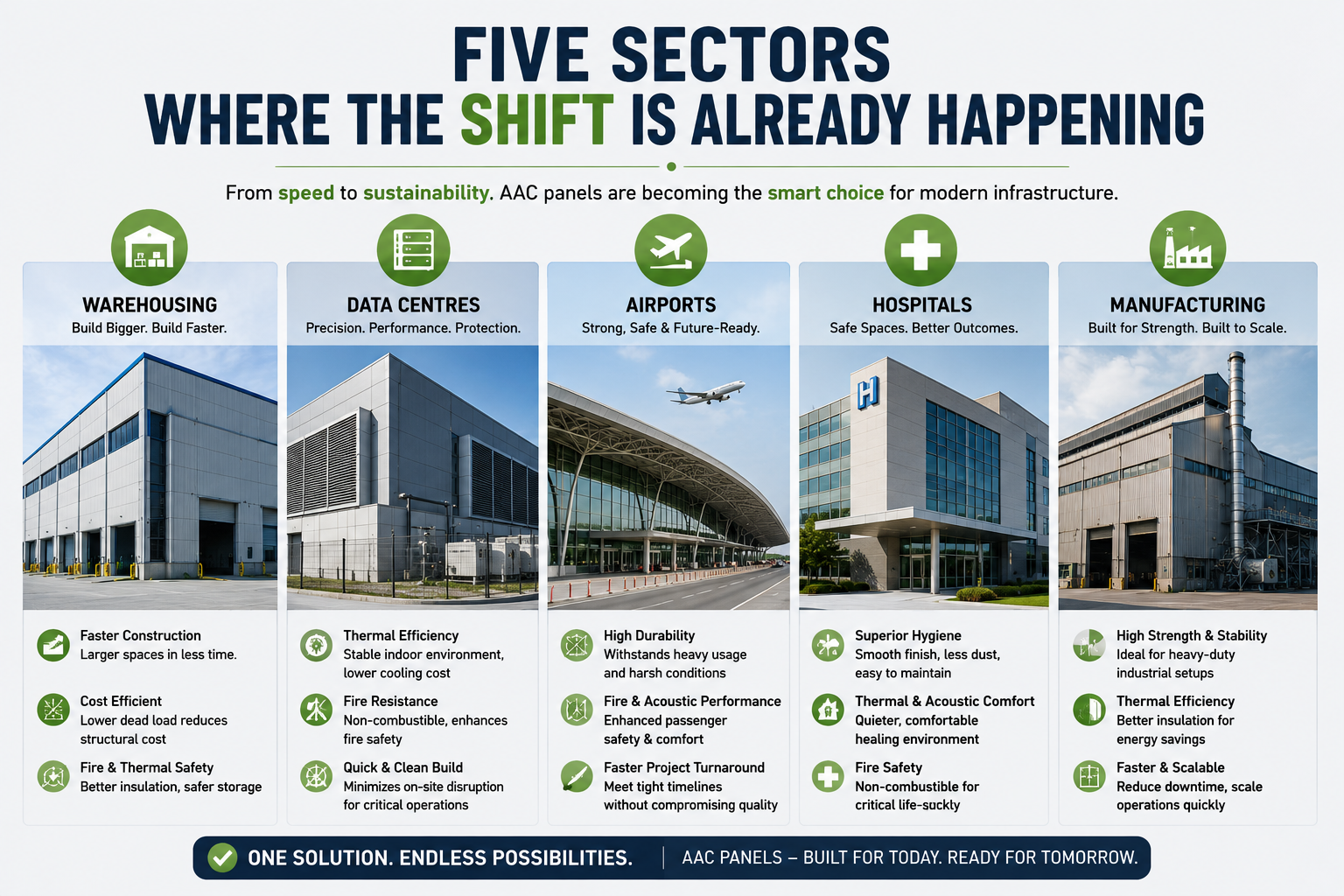
Five Sectors Where the Shift Is Already Happening
 1. Warehousing and Logistics
A logistics hub in Maharashtra set the benchmark for what industrialised wall construction can deliver. The project mandate was unambiguous: 10,000 sq. ft. of warehouse envelope, fully watertight, before monsoon onset. Using Magicrete 100 mm AAC Wall Panels installed with crane-assisted erection on a PEB frame, the team achieved exactly that in 10 days.
Explore more use cases of AAC wall panel applications across infrastructure projects.
Installation speed was approximately 12 times faster than brick masonry and 4 times faster than conventional AAC blockwork. MEP works commenced weeks ahead of the original schedule. Zero internal plastering was required. For warehouse developers catering to 3PL tenants with FM Global compliance requirements, the fire rating and the predictable delivery timeline are equally critical.
2. Data Centres
The STT Pune DC-04 facility, subsequently occupied in full by Microsoft, demonstrated how AAC panels resolve the Tier III wall specification problem. The switch from 200 mm solid concrete blocks to 150 mm AAC panels delivered equivalent structural and fire performance with a smaller footprint, lower dead load, and significantly compressed construction timelines. STT returned with Magicrete for DC-05.
For thermal efficiency benefits, see thermal insulation benefits of AAC blocks.
For data centre developers, the thermal value is particularly consequential. A wall with a K-value of 0.16 W/mK versus 2.1 W/mK (dense concrete) translates directly into lower PUE ratios and reduced cooling infrastructure cost, a competitive advantage at the asset level, not just the construction phase.
3. Airports and Rail Infrastructure
At the Mopa International Airport in Goa, and across bullet train and metro station projects nationally, Magicrete AAC panels were selected because they address the unique constraint of construction within or adjacent to live operational environments. Dry installation generates no slurry, no curing water, and minimal vibration, critical requirements when working near active runways, live rail lines, or operational terminal zones.
Precision matters here too. Factory-manufactured panels arrive to site with tolerances that brickwork simply cannot match, reducing rework on projects where dimensional accuracy feeds directly into systems integration, glass facades, curtain walls, MEP containment.
4. Hospitals and Healthcare Facilities
Healthcare construction has a constraint that most sectors do not: the building may need to remain partially operational throughout. A hospital expanding its ICU wing cannot afford masonry dust migrating into adjacent wards. It cannot tolerate extended curing timelines that delay handover of life-critical spaces.
Dry AAC panel installation eliminates both problems. At hospital projects in Mumbai and a Bengaluru facility where fire-rated panels were deployed throughout, the system enabled construction to proceed without compromising adjacent operations. NABH-aligned healthcare PMCs are increasingly specifying panel systems as a baseline requirement for expansion projects.
5. Industrial and Manufacturing Plants
Manufacturing facilities, semiconductor fabs, pharmaceutical plants, EV battery lines require walls that can span crane bay heights of 5–6 metres without intermediate bond-beam, resist chemical vapour permeation, and be delivered before equipment installation must begin. Steel-reinforced AAC panels spanning up to 6 metres without beams answer this requirement directly.
Foxconn's manufacturing facility in Bengaluru is among the projects where Magicrete panels were deployed at industrial scale, enabling rapid enclosure of large-footprint production zones within compressed commissioning windows.
From Wall Material to Construction System
The most important reframe for project teams evaluating AAC panels is this: they are not a walling material; they are a construction system. The panel itself is the beginning of the value chain.
This approach aligns with modern trends in modern walling systems in construction.
Magicrete's supply-and-erect capability, factory production, logistics, crane-assisted installation, and site technical support means the system is managed as a single scope item. This eliminates the coordination friction between material supplier, block layer, plasterer, and finishing contractor. On a 50,000 sq. ft. project, this friction is not a minor inconvenience. It is typically where months disappear from the schedule.
The downstream effects compound. Early building enclosure means MEP teams can mobilise weeks ahead. No plastering means finishes can begin immediately after panel erection. Lighter walls mean structural savings at the foundation and frame level, up to 15% in structural steel on certain building typologies. And BIS certification, GRIHA recognition, and NBC 2016 compliance mean no regulatory delays on project approvals.
The Infrastructure Window Is Closing Fast
India's infrastructure pipeline, data centres, greenfield airports, logistics parks under the PM GatiShakti framework, hospital expansions under Ayushman Bharat, represents the largest construction opportunity in the country's history. Every one of these projects has a deadline that is not negotiable. Penalties for delay are contractual. Occupancy dates are tied to funding tranches and tenant agreements.
EPC contractors and developers who are still evaluating AAC wall panels as an "alternative" are misreading the market. These systems are already the delivery mechanism of choice on India's most demanding sites. The question is not whether to adopt them. It is how quickly the transition can be made on upcoming projects.
Magicrete AAC Wall Panels are deployed across data centres, airports, metro stations, hospitals, warehouses, and manufacturing plants across India.Speak to the Magicrete technical team to understand how panel systems can be integrated into your next project's construction programme.
One-Stop Solution for all your Construction Needs
Contact Us