bot
aac-wall-panel-systems-infrastructure-india
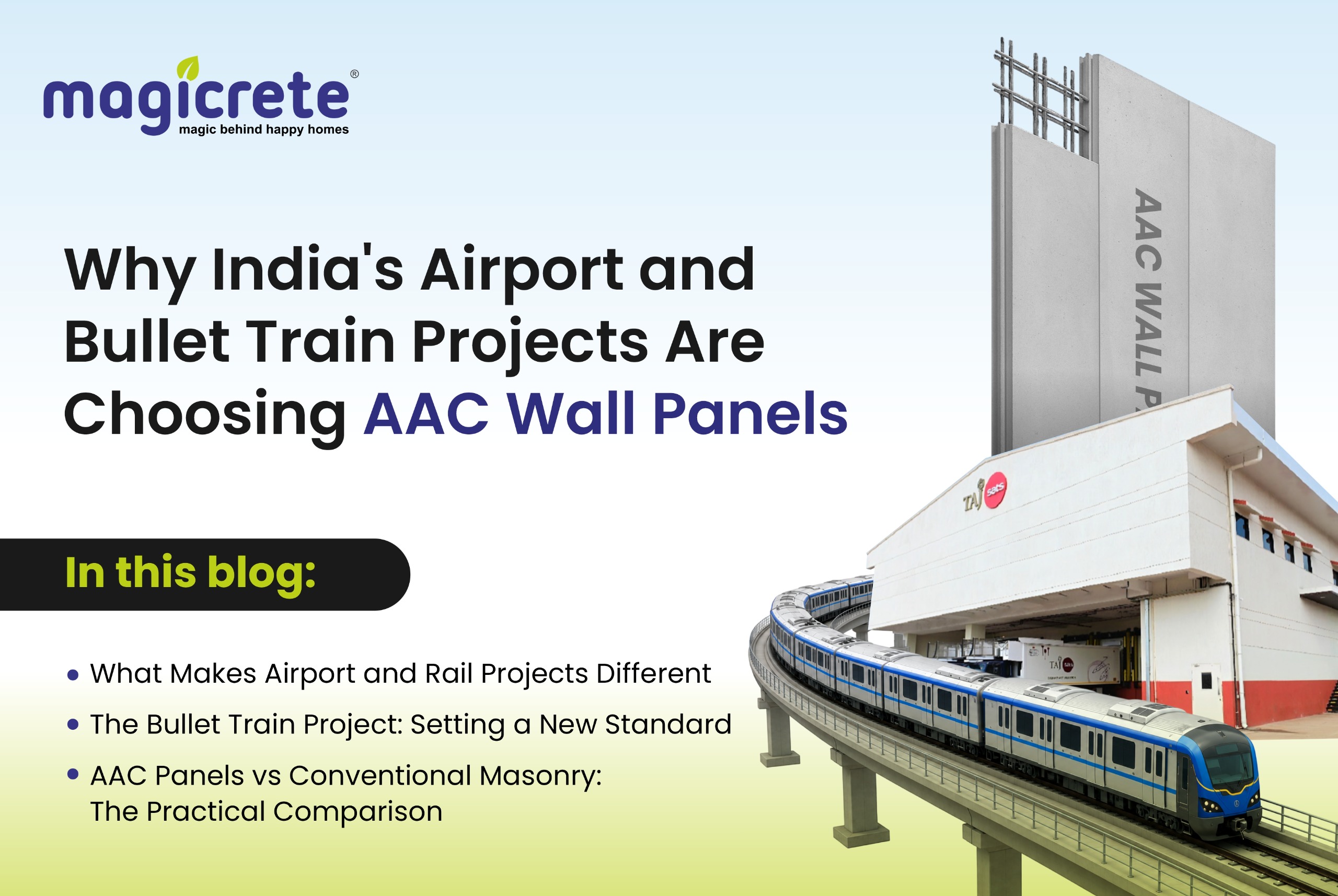
  • Why India's Airport and Bullet Train Projects Are Choosing AAC Wall Panels

  • User

    Magicrete

    02 Jun 2026

Introduction

India is building the transport infrastructure of the future, yet many sites are still attempting to deliver it using the brick-and-mortar methods of the past. When the Mumbai-Ahmedabad High Speed Rail Corridor needed wall systems for its stations, the team set standards that most Indian construction sites have never dealt with before. Every wall had to be perfectly level. Every surface had to be finished to the point where no plastering was needed. And the entire process had to be fast, with no wet trades slowing things down.

Magicrete AAC Wall Panels were selected for this project because brick walls and conventional blocks simply could not meet the demands of this project, in speed, consistency, or performance. Unlike traditional masonry, AAC Wall Panels arrive factory-precision engineered, install dry with no plastering cycle, and deliver ten times faster construction while being five times lighter than dense concrete. They simultaneously address structural dead load, thermal comfort, fire safety, and acoustic performance 

This is not an isolated example. Across India's growing pipeline of airports and aviation facilities, the same questions are being asking and AAC wall panels are increasingly providing the answers.

What Makes Airport and Rail Projects Different

When it comes to modern walling systems for infrastructure projects, building an airport terminal or a high-speed rail station is not the same as building a warehouse or an office block. The requirements are stricter, the tolerances are tighter and the penalties for delay are real.

EPC contractors and project consultants currently face three non-negotiable pressures:

Strict Tolerance Requirements

Airports and rail stations integrate complex glass facades, automated doors and pre-fabricated MEP (Mechanical, Electrical, and Plumbing) systems. If the underlying wall is misaligned by even a few millimeters, the entire system fails to fit.

The "No Wet Trade" Mandate

In a terminal or station building, water-intensive construction, mixing mortar, wetting blocks and applying plaster creates humidity, dust, and mess. These compromises surrounding equipment and prevents parallel finishing trades from starting.

Accelerated Timelines

Aviation and rail projects are tied to rigid opening dates, commercial leases and government mandates. There is zero margin for the 14-day curing cycles inherent in traditional masonry.

The Bullet Train Project: Setting a New Standard

The Mumbai-Ahmedabad High-Speed Rail Corridor is, perhaps, the most stringent proving ground in modern Indian construction. Being built with Japanese technical oversight, the project demands construction standards that exceed typical Indian benchmarks.

When the project team evaluated wall systems for station construction, they required a solution that could match the precision of their structural design. Magicrete AAC Wall Panels were selected to meet this challenge. This wasn't just a material choice; it was a technical necessity for several reasons:

Magicrete AAC Wall Panels met this standard across several key requirements:

  • Panels arrive at site with consistent dimensions, so walls align correctly with pre-made furniture, signage, and facade systems from the start

  • Steel-reinforced panels span up to 6 metres between floor and ceiling without needing extra columns or beams in between

  • No plastering is needed after installation, other trades can follow immediately

  • 4-hour fire resistance, certified under IS 3809, meeting the fire safety requirement for public transport infrastructure

The significance here goes beyond the project itself. When a project with international technical oversight selects a walling system, it sets a reference point. EPC contractors and consultants working on comparable projects new airport terminals, rail depots, transport hubs now have a real-world benchmark to point to.

Taj SATS at Mopa Airport, Goa: A Completed Delivery

Magicrete has completed the supply and erection of AAC Wall Panels for the Taj SATS airside catering facility at Mopa International Airport, Goa. This was not a straightforward project; it carried two very different sets of requirements at the same time.

As an airport facility, the building needed to meet structural and fire safety standards set for aviation infrastructure. As an in-flight catering kitchen certified for international operations, it also needed walls that are smooth, non-porous and easy to clean, the kind of surface that food safety auditors look for. AAC panels addressed both requirements cleanly.

On the fire side, Magicrete AAC panels carry a 4-hour fire resistance rating. This met the requirement for the airport perimeter location without needing extra fire protection systems layered on top.

AAC Panels vs Conventional Masonry: The Practical Comparison

For any project team evaluating AAC panels vs other wall systems for an aviation or rail project, the comparison comes down to a handful of factors that actually affect the build:

What matters on site

Brick / block masonry

AAC wall panels

Wall straightness and finish

Varies — depends on the mason, needs plastering to meet standard

Consistent — factory-made to tight tolerances, no plastering needed

Dust and mess during installation

High — mortar mixing and brick cutting generate dust

Minimal — panels are pre-cut, no wet mixing on site

Water use on site

Significant — mortar, block wetting, curing

Negligible — dry installation

Time before next trade can start

7–14 days — plastering, curing, and drying all take time

Immediate — factory finish means other trades can follow straight away

Fire resistance (100 mm)

Varies by block type and mortar mix

4 hours — certified under IS 3809

Wall height without extra structure (up to 6m)

Not achievable — needs intermediate columns or beams

Achievable — steel-reinforced panels stand independently up to 6 m

India's Airport Pipeline and What It Means for Wall Specifications

India is in the middle of the largest airport expansion in its history. Under the UDAN scheme, the Airports Authority of India is upgrading dozens of airports across Tier 2 and Tier 3 cities. New greenfield airports, Navi Mumbai, Jewar in Uttar Pradesh, Bhogapuram in Andhra Pradesh are moving through planning and construction stages.

Each of these projects involves large areas of AAC wall panel applications across infrastructure buildings, terminals, cargo buildings, catering facilities and ground services infrastructure.

All of it needs to be built fast, built right the first time, and meet the fire and structural codes that apply to public aviation facilities.

The work already done at Mopa and on the bullet train corridor gives Magicrete an established track record for exactly this type of project. For EPC contractors and consultants evaluating AAC panels for upcoming aviation or rail projects, that track record is not a claim, it is a completed reference.


Magicrete has supplied and erected AAC Wall Panels on the Mumbai-Ahmedabad bullet train corridor and at the Taj SATS facility, Mopa International Airport, Goa. Contact the Magicrete team to talk through your airport or rail infrastructure project.