
-
Why Exterior Tile Adhesive is a Necessity, Not a Choice?
-

Introduction
Exterior tiling is one of the most failure-prone applications in modern construction. Unlike interiors, where conditions are controlled, exterior facades face a relentless cycle of environmental stress: sunlight, rain, humidity, and structural movement.
Yet, many projects still rely on traditional sand-cement mortar—a legacy method that is increasingly proving inadequate for modern materials like vitrified tiles and large-format stone, highlighting the difference between cement and tile adhesive.
This guide explains the technical reasons why exterior tile adhesive is a performance necessity for ensuring the longevity and safety of outdoor cladding.
Why Do Exterior Tiles Fail First?
Most tile failures begin on the building’s envelope. To understand the solution, we must first diagnose the problem. Exterior surfaces face forces that interior floors never experience:
- Thermal Shock: Daily heat cycles cause rapid expansion and contraction.
- Moisture Penetration: Rain and humidity seep into substrates, leading to pressure buildup.
- UV Radiation: Constant exposure weakens standard bonding layers over time.
While tiles themselves are engineered for outdoor durability, the bonding system beneath them often is not. If the fixing material cannot handle these stresses, it becomes the weakest link.
Why Cement Mortar Falls Short Outdoors?
Historically, tile mortar (a mix of cement, sand, and water) worked fine for porous clay tiles. However, with the shift toward low-porosity vitrified and porcelain tiles, mortars limitations are exposed.
1. The "Rigidity" Problem
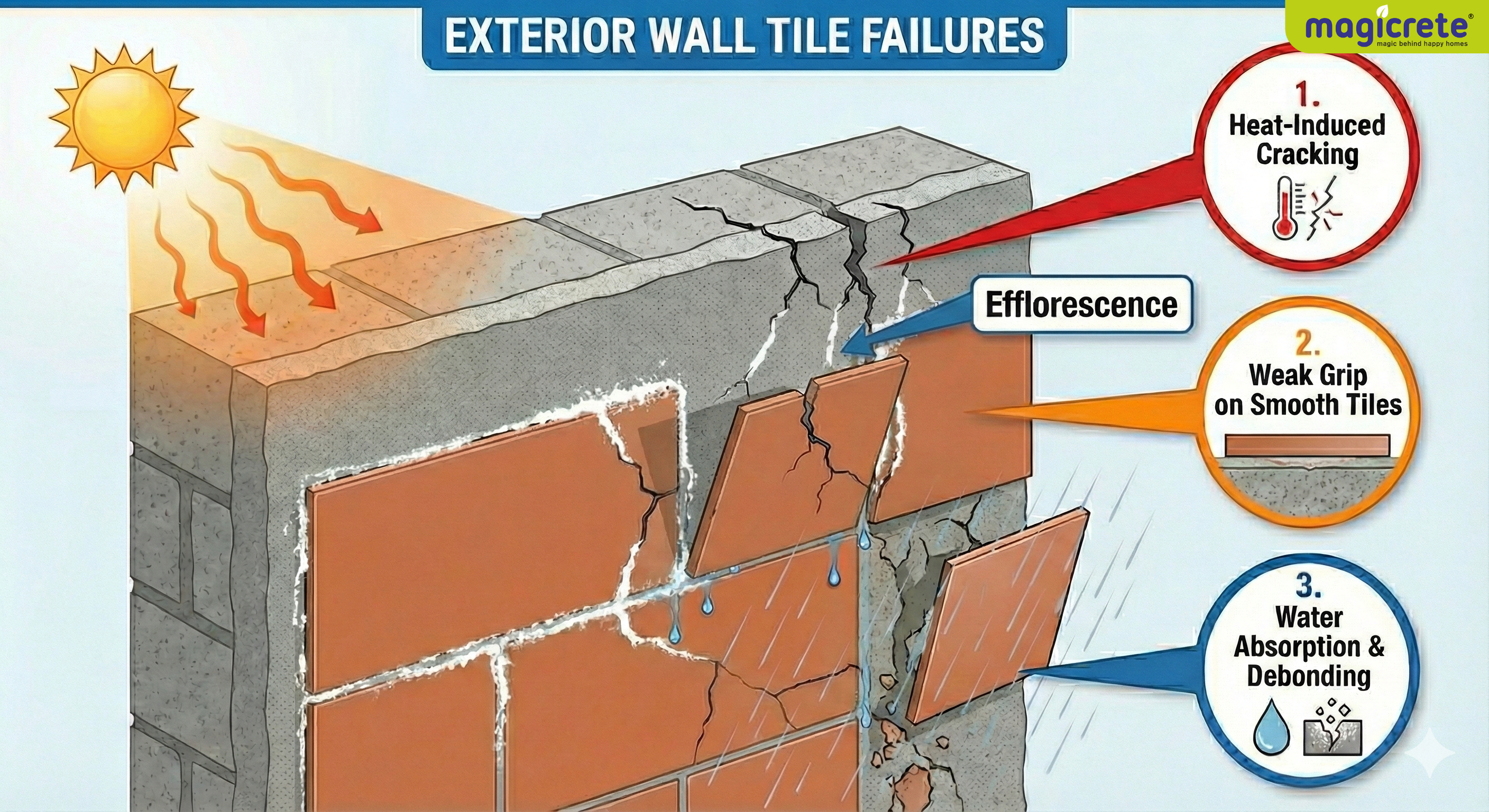
Cement mortar cures into a rigid, brittle layer. When a buildings exterior wall expands due to heat, rigid mortar cannot stretch. Instead, the stress builds up at the interface until the bond snaps, leading to cracking or debonding.
2. Failure of Mechanical Bonding
Traditional mortar relies on "mechanical interlocking", it seeps into the pores of a tile to grip it.
- The Issue: Modern vitrified tiles are dense and non-porous (water absorption <0.5%).
- The Result: Mortar has no pores to grip. Without chemical additives, it struggles to hold smooth, modern tiles vertically.
3. Water Absorption Risks
Sand-cement mortar is highly porous. It absorbs rainwater, which can get trapped behind the tile. This leads to efflorescence (white salt stains) and, in colder climates, freeze-thaw damage that pushes the tile away from the wall.
The Solution: Why Exterior Tile Adhesive Works?
Exterior tile adhesives are engineered Polymers designed specifically to handle movement, moisture and non-porous surfaces, in line with tile adhesive classifications and standards for modern construction.
Flexible "Shock Absorption"
Exterior adhesives are polymer-modified. This gives the bonding layer deformability, the ability to stretch slightly.
- Handling Heat: When the facade heats up, the adhesive absorbs the thermal expansion stress rather than cracking.
- Structural Movement: It accommodates minor building settlement and vibration without losing its grip.
Chemical vs. Mechanical Bonding
Since modern tiles do not allow water to penetrate, adhesives use chemical cross-linking rather than just mechanical grip. This ensures a permanent bond on vitrified tiles, porcelain and stone, even on vertical heights.
Superior Water Resistance
High-quality exterior adhesives are hydrophobic, a defining characteristic if water-resistant tile adhesives used in exposed environments. They significantly reduce water, protecting the substrate from dampness and preventing the "hollow sound" caused by water damage.
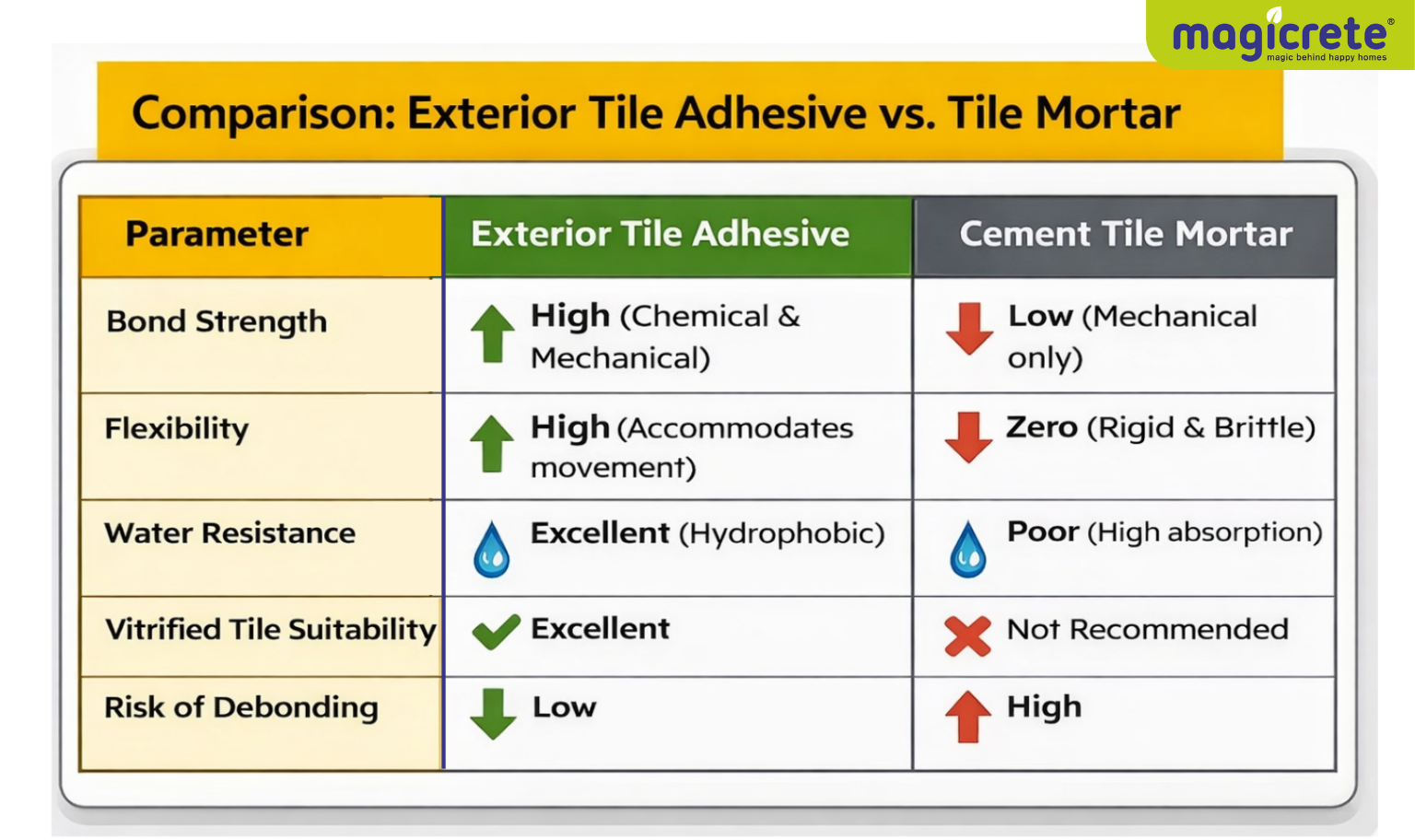
Comparison: Exterior Tile Adhesive vs. Tile Mortar
Long-Term Cost: The "Total Cost of Ownership"
A common misconception is that tile mortar is cheaper. While the raw material cost of sand and cement is lower, this ignores the lifecycle cost.
- Usage Volume: Mortar requires thick beds (15–20mm), consuming huge amounts of material. Adhesive uses a "thin-bed" method (~6mm), covering more area with less product.
- The Cost of Failure: Replacing a failed facade is exponentially expensive. It involves scaffolding, labor and safety risks.
- Safety Liability: In vertical applications, a falling tile is a major safety hazard.
When you factor in the lack of rework and zero maintenance, exterior tile adhesive is the more economical choice in the long run.
Where Should You Use Exterior Tile Adhesive?
- Building Facades: Essential for safety on vertical high-rises.
- Balconies & Terraces: Critical for areas exposed to standing water and foot traffic.
- External Staircases: Ensures stair treads remain secure under dynamic loads.
- Compound Walls: Prevents detachment on exposed boundary structures.
Conclusion
In modern construction, using tile mortar for exterior cladding is a calculated risk that often fails, making it one of the common tile installation mistakes seen on facades. Exterior tile adhesive is not just a premium upgrade; it is a technical requirement for modern vitrified tiles and outdoor environments.
Do not compromise your building's envelope with outdated methods. Ensure longevity, safety, and aesthetics by choosing the right bonding system.
For a solution that guarantees performance, Magicrete Tile Adhesive Ultima is the definitive choice for external walls. Engineered to withstand severe thermal stress and structural movement, it is fully compliant with the highest European standard (C1, C2) and Indian Standard IS 15477:2019 Type 4 standards.
Stop risking your facade. Secure your exterior cladding with Magicrete Tile Adhesive today.
FAQs
1. Can cement mortar be used for exterior tiles?
While it is physically possible, it is not recommended for modern vitrified or porcelain tiles. Mortar lacks the flexibility to handle thermal expansion and cannot form a strong chemical bond with low-porosity tiles.
2. Is exterior tile adhesive waterproof?
Most exterior adhesives are highly water-resistant and designed to limit moisture ingress. However, for areas like terraces, they should be used in conjunction with a proper waterproofing membrane.
3. Does tile adhesive handle heat better than mortar?
Yes. Exterior adhesives are polymer-modified to accommodate thermal expansion and contraction (thermal shock) caused by direct sunlight, preventing tiles from popping up.
4. What thickness is ideal for exterior tile adhesive?
Unlike mortar which requires 15–20mm, tile adhesive is applied in a "thin bed," typically between 3mm to 6mm, depending on the tile size and substrate flatness.
5. Is tile adhesive suitable for heavy stone cladding?
Yes, but you must select a specific ‘Type 2’ or ‘Type 4’ adhesive designed for heavy vertical applications, which makes knowing how to choose the right tile adhesive Critical.
One-Stop Solution for all your Construction Needs
Contact Us